
Your team can write great SEO content and still lose weeks to the same busywork: picking topics, building briefs, checking on-page SEO, moving drafts through approvals, then copying everything into the CMS. SEO.ai vs Balzac comes down to who owns that work after the first draft.
SEO.ai is an seo ai writer with SEO suggestions inside a human-led workflow. Balzac is built for hands-off teams: it can plan what to publish, use Google Search Console data, track keywords over time, and push posts straight into your CMS with optional approvals.
The table below is here for one purpose: help you decide whether you want a tool that helps writers move faster, or a system that keeps shipping content when nobody has time to babysit it.
| Feature | Balzac | SEO.ai |
|---|---|---|
| Autonomy Level | Autonomous agent, can run end-to-end workflows | Assisted writing tool, humans run the workflow |
| Google Search Console (GSC) Integration | Yes, uses GSC data to guide decisions | Not a core workflow dependency |
| Keyword Tracking | Built-in tracking to monitor performance over time | Primarily focused on writing and on-page guidance |
| Content Planning | Automated planning based on site and search data | Team-led planning, tool supports execution |
| CMS Publishing | Direct publishing to major CMS platforms | Manual publishing |
| Approvals And Editorial Control | Optional approvals, designed for hands-off operation | Built for human review and manual control |
| Best Fit | Lean teams that want a seo.ai alternative for zero-touch SEO content | Content teams that want an seo ai writer with SEO suggestions |
If your operating model is editorial-led, with writers and reviewers deciding what goes live, SEO.ai will feel natural. If your goal is a zero-touch publishing loop that learns from performance data and keeps output steady, Balzac is the closer match.
What Is the Real Difference Between SEO.ai and Balzac?
The real difference in SEO.ai vs Balzac is who does the work after the draft exists. SEO.ai behaves like an seo ai writer with SEO guardrails: it helps a person write faster and optimize on-page elements, then the team still runs the workflow. Balzac behaves like an autonomous SEO agent: it plans, writes, optimizes, publishes, and learns from performance data with minimal human touch.
If you are evaluating an seo.ai alternative, ask one question: do you want assistance inside the editor, or do you want the system to own the full publishing loop?
Assisted Writing vs Autonomous Publishing
SEO.ai fits teams that already have an editorial process and want better execution inside it. A human typically selects topics, checks claims, adjusts tone, coordinates stakeholders, and publishes in the CMS. SEO.ai adds speed and on-page guidance, but it does not replace the operational layer that keeps content shipping week after week.
Balzac targets the opposite constraint: teams that cannot spare people for briefs, internal handoffs, and calendar maintenance. Balzac runs a zero-touch loop: it generates a plan, produces articles, applies SEO optimization, and publishes directly to the CMS. The workflow stays consistent even when the marketing team is busy with launches, sales enablement, or customer work.
The autonomy gap shows up in day-to-day operations:
- Data inputs: Balzac connects to Google Search Console (GSC) to ground decisions in real query and page performance. SEO.ai typically relies on what the user provides in the session and whatever keyword research the team brings in.
- Keyword tracking: Balzac tracks keywords and uses movement over time to adjust what it publishes next. With SEO.ai, teams usually track rankings in a separate platform such as Semrush or Ahrefs, then manually feed insights back into planning.
- Publishing: Balzac publishes to a CMS without a person moving drafts between tools. With SEO.ai, publishing remains a manual step, which also means manual QA, formatting, internal links, and scheduling.
Think of SEO.ai as a productivity upgrade for writers. Think of Balzac as an operations replacement for content teams that want output without meetings, queues, and constant follow-up.
1. Balzac
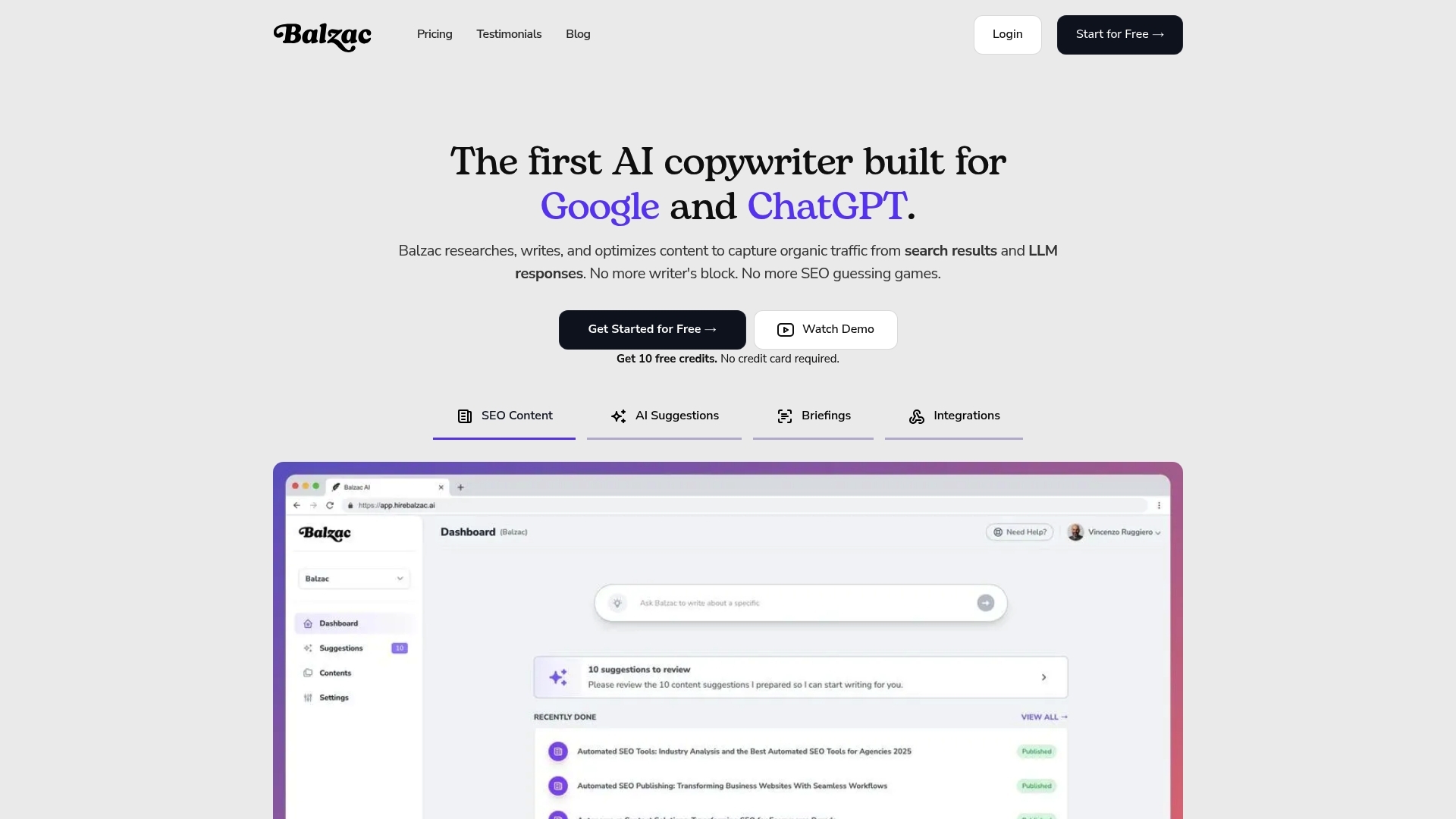
Balzac is the seo.ai alternative you pick when you want content operations to run without a weekly standup. It behaves like an autonomous SEO agent: it decides what to publish next, produces the draft, optimizes it, then pushes it live. Your team sets guardrails and reviews exceptions instead of moving tickets across tools.
The simplest way to understand Balzac is its loop: plan → write → optimize → publish. Each step uses live site and search data so the system can keep shipping and learning.
- Plan: Balzac builds a content plan from your site context and search performance. It prioritizes topics based on what your domain can realistically win, instead of generic keyword lists.
- Write: Balzac generates full articles mapped to a target query and intent. It aims for publish-ready structure (headings, sections, internal logic) so editors spend time on judgment, not formatting.
- Optimize: Balzac tunes on-page SEO before publishing. That includes aligning titles and headings to the query, covering the subtopics searchers expect, and avoiding common SEO mistakes like thin intros or off-intent sections.
- Publish: Balzac can publish directly to major CMS platforms. That matters if your bottleneck is the last mile, copying drafts into WordPress, adding metadata, and hitting publish.
GSC Integration And Keyword Tracking Change The Workflow
In a typical SEO.ai vs Balzac evaluation, this is where the gap shows up. Balzac connects to Google Search Console (GSC) and uses that data as an input, then tracks results over time. That turns SEO from a one-time writing task into an operating loop.
- GSC integration means Balzac can react to real queries and performance patterns from your property, not a static brief.
- Keyword tracking means you can monitor whether published pages move, then feed that back into what gets written next.
Teams that benefit most look like this: one content lead, limited editorial bandwidth, and a mandate to publish consistently. If your process depends on heavy brand review, custom SME interviews, or pixel-perfect editorial voice in every paragraph, Balzac still works, but you will use approvals more often and the workflow becomes less zero-touch.
2. SEO.ai
Teams with heavy brand review or SME sign-off usually prefer SEO.ai vs Balzac in the opposite direction: they want an seo ai writer that speeds up drafting, then they want humans to control every decision before anything goes live. That is where SEO.ai shines. It supports a writer-led workflow with on-page guidance, templates, and manual publishing control.
SEO.ai works best when your bottleneck is production time, not content operations. You pick the topic, write with assistance, review internally, then publish in WordPress, Webflow, HubSpot, or whatever CMS you run. If you are looking for a seo.ai alternative because you want zero-touch publishing, SEO.ai will feel too hands-on by design.
Where SEO.ai Fits in a Human-Led SEO Workflow
SEO.ai is a good fit when you already run a content process and want better execution inside the editor. In practice, teams use SEO.ai to:
- Draft faster with guardrails: Writers get direction on headings, keyword use, and on-page structure while they write.
- Work from repeatable templates: Templates help standardize formats like listicles, landing pages, and product-led blog posts.
- Keep editorial ownership: Humans decide what to say, what to exclude, and how to handle sensitive claims.
- Maintain manual QA: Teams can enforce brand voice, legal review, and fact-checking before publishing.
That manual control matters in regulated industries, high-stakes B2B, and companies with strict brand standards. A content manager can route drafts through Google Docs, Notion, or a CMS draft, then run final checks on internal links, product positioning, and compliance language.
The tradeoff is operational effort. SEO.ai does not run an autonomous loop with Google Search Console-driven topic selection, built-in keyword tracking feedback, and direct CMS publishing. Most teams pair SEO.ai with separate SEO tooling such as Semrush or Ahrefs for research and rank monitoring, then translate those insights back into the next briefs.
If your team wants an seo ai writer that stays inside a human-owned workflow, SEO.ai fits. If you want the system to plan, publish, and learn from performance without a person moving drafts around, Balzac targets that job.
3. Surfer SEO
Surfer SEO is a strong fit when you want an optimization layer, not an autonomous publishing loop. In an SEO.ai vs Balzac decision, Surfer sits closer to SEO.ai: it helps humans write and optimize based on what ranks, then your team still handles planning, approvals, and CMS publishing.
Content teams use Surfer SEO when they already have writers in Google Docs, Notion, or WordPress, and they want SERP-driven guidance that reduces guesswork. It is less of an seo.ai alternative for “write for me” and more of a “grade and guide what we write” system.
How Surfer SEO Works In A Human-Led Workflow
Surfer SEO centers on its Content Editor, which analyzes pages ranking for a query and turns that into a real-time content score. You typically bring your own topic, outline, and draft. Surfer SEO gives you constraints and targets based on competitor pages.
- SERP-based content scoring: Surfer SEO recommends terms, headings, and approximate length ranges based on top results, then updates a score as you edit.
- Briefs and outlines: Surfer SEO can generate a content brief from SERP analysis so writers start with a structure aligned to search intent.
- Keyword and NLP suggestions: Surfer SEO suggests related phrases to cover, which helps teams avoid missing subtopics that show up repeatedly in ranking pages.
- Integrations: Surfer SEO commonly runs alongside Google Docs and WordPress workflows, so editors can optimize without rewriting everything inside a new tool.
Surfer SEO works best when your bottleneck is on-page optimization quality. It does not solve the operational problem Balzac targets: choosing what to publish next from performance data, tracking movement over time, then publishing directly to a CMS without someone pushing drafts around.
If your team wants an seo ai writer with built-in guidance, SEO.ai feels more like a writing environment. If your team already writes elsewhere and wants a scoring system tied to what ranks, Surfer SEO is the cleaner add-on.
4. Clearscope
Surfer SEO is great when you want a score tied to SERPs. Clearscope is the premium option when your main job is editorial optimization of drafts that already exist. If you are comparing seo.ai vs balzac and you are also weighing tools that grade content quality, Clearscope sits in a different lane: it does not try to run your workflow, it grades how well a draft covers a topic.
Clearscope is a content optimization platform that analyzes top-ranking pages and gives your draft a letter grade, plus a list of recommended terms and topics to include. Editors use Clearscope to tighten relevance, improve topical coverage, and standardize what “good” looks like across a team.
Where Clearscope Fits in a Content Team Stack
Clearscope works best when you already have writers, a review process, and a publishing pipeline. It is common in B2B SaaS, agencies, and editorial teams updating existing libraries. The workflow is simple: paste a draft, pick a target keyword, then revise until the grade and coverage meet your internal bar.
- Refreshing legacy content: Clearscope helps when a 2022 post drifts off-intent or misses subtopics that newer ranking pages cover.
- Editing for consistency: A managing editor can require a minimum grade before a draft moves to the CMS.
- Training newer writers: The term list and competitor outlines give concrete guidance without rewriting the whole brief.
Clearscope also pairs cleanly with human-led writing tools. A team might draft in Google Docs, Notion, or an seo ai writer like SEO.ai, then use Clearscope as the final optimization pass before manual publishing.
Clearscope is not a zero-touch system, and it is not an seo.ai alternative in the operational sense. It does not connect to Google Search Console to pick topics, it does not track keyword movement as a feedback loop, and it does not publish to WordPress, Webflow, or HubSpot. You still need a separate process for planning, internal linking, metadata, and shipping content on schedule.
If your bottleneck is editorial polish and topic coverage, Clearscope earns its price. If your bottleneck is getting content out the door without constant coordination, an autonomous system like Balzac targets that problem directly.
5. Frase
Frase sits in the middle ground between an seo.ai alternative like Balzac and a pure editor-first tool like SEO.ai. In an SEO.ai vs Balzac conversation, Frase usually comes up when the team wants better SERP research and brief creation, but still wants humans to write, edit, and publish in the CMS.
Frase is best known for turning a target query into a content brief fast. It pulls competitor pages, extracts recurring headings and topics, and gives writers a structure to follow. That makes it useful when your bottleneck is research time and outline quality, not the act of drafting itself.
Frase Is A SERP Research-First Workflow
Frase starts with analysis of pages already ranking for a query, then maps that into guidance a writer can use. The workflow is typically:
- Choose a query: A content lead picks the keyword and intent, often from Semrush, Ahrefs, or internal data.
- Build a brief: Frase generates an outline, topic suggestions, and questions to answer based on competitor coverage.
- Draft with guidance: Writers produce the article in Frase or export the brief to Google Docs or WordPress.
- Optimize and ship: A human still handles internal linking, metadata, formatting, and publishing.
That last step is the difference content managers feel immediately. Frase improves the inputs to writing, but it does not run a zero-touch loop with Google Search Console-driven prioritization, built-in keyword tracking feedback, and direct CMS publishing.
Frase also fits teams that want consistent brief quality across writers. A junior writer can start with a SERP-informed structure instead of a blank page, and an editor can review coverage before spending time on line edits.
If you want an seo ai writer experience inside the drafting environment, SEO.ai tends to feel more like the writing tool. If you want SERP research and briefs that tighten up what humans produce, Frase is a practical add-on. If your goal is to publish continuously without someone managing briefs and pushing drafts into WordPress or Webflow, Balzac targets that operational gap directly.
6. Jasper
Jasper is a strong option when you want a general-purpose AI writing platform, not a zero-touch SEO system. In a typical seo.ai vs balzac evaluation, Jasper sits even further from autonomous SEO operations than either tool: it helps teams produce on-brand copy across channels, then humans handle keyword research, on-page SEO checks, and publishing.
If you are searching for an seo.ai alternative because you want content to plan itself, learn from Google Search Console, and publish to a CMS automatically, Jasper is usually the wrong category. If you need fast campaign output with consistent voice, Jasper is in its element.
Where Jasper Fits Best: Brand Voice And Campaign Production
Marketing teams use Jasper for high-volume writing where brand consistency matters more than SEO automation. Jasper focuses on helping people write faster inside a controlled style and messaging framework.
- Campaign assets: paid social variants, landing page sections, email sequences, webinar abstracts, and nurture copy.
- Brand voice controls: teams set style guidance so multiple marketers can ship copy that sounds consistent.
- Repurposing: turn a product brief into ad copy, a blog intro, and an email, then edit manually for channel fit.
- Collaboration: useful when several stakeholders need to review and iterate on messaging.
This is why Jasper often shows up in demand gen teams, product marketing teams, and agencies that produce lots of creative variations per week.
Jasper is not an seo ai writer in the same way SEO.ai positions itself. SEO.ai puts on-page SEO guidance inside the drafting workflow. Jasper typically relies on your team to bring the SEO inputs, the target query, the outline, the internal links, and the metadata.
Operationally, Jasper also does not compete with Balzac’s model. Jasper does not run an end-to-end loop that chooses what to publish next from performance data, tracks keyword movement as feedback, then pushes finished posts into WordPress or Webflow without human involvement.
Pick Jasper when your content calendar includes lots of non-SEO work and you want one writing environment for it. Pick SEO.ai when you want SEO guidance inside writing. Pick Balzac when you want the publishing loop to run with minimal human touch.
7. Semrush ContentShake AI
Semrush ContentShake AI is a common stop for teams comparing SEO.ai vs Balzac because it sits closer to “draft help” than “autonomous publishing.” It is a Semrush-connected writing experience that helps you find topics, generate outlines, and produce first drafts, then you finish the SEO ops and publishing work yourself.
ContentShake AI makes the most sense if your team already lives in Semrush for keyword research and competitive analysis. It keeps ideation and drafting tied to that ecosystem, instead of asking you to move between a separate seo ai writer and your research tool.
Where ContentShake AI Fits (And Where It Stops)
ContentShake AI is useful for getting from a blank page to a structured draft quickly. It typically supports workflows like:
- Topic discovery: Generate ideas based on Semrush data and SERP patterns, then pick what aligns with your priorities.
- Outlines and drafts: Produce an initial article structure and copy that a writer or editor can refine.
- Basic SEO guidance: Keep the draft pointed at a target query and intent, with Semrush context close at hand.
The handoff happens after the draft. Most teams still do these steps outside ContentShake AI:
- Operational SEO: Decide what ships this week, manage internal links, handle cannibalization, and coordinate updates across the library.
- Performance feedback: Track rankings and clicks, then translate those insights into the next briefs. Semrush can track keywords, but the workflow remains human-driven.
- Publishing: Move the finished draft into WordPress, Webflow, or HubSpot, then format, add metadata, and schedule.
If you want a Semrush-first drafting tool, ContentShake AI can replace part of what an seo ai writer does. If you are looking for an seo.ai alternative because you want zero-touch execution, ContentShake AI will still leave you with the same bottlenecks: planning, QA, and the last mile into the CMS. That is the gap autonomous systems like Balzac are built to close.
For reference on the broader platform ContentShake AI connects to, see Semrush, the SEO and competitive research suite most teams use for keyword research and rank tracking.
Which Should You Choose for Zero-Touch SEO Content in 2026?
If you are deciding between SEO.ai vs Balzac for zero-touch SEO content in 2026, ignore feature checklists for a second and look at your operating model. Tools like Semrush can tell you what to target. The real question is who turns that insight into published pages every week: your team, or the system.
Decision Checklist: Hands-Off Ops vs Editorial-Led Control
- Choose Balzac if your bottleneck is operations. You want the software to plan topics, write drafts, optimize on-page SEO, and publish to your CMS without someone moving documents around.
- Choose SEO.ai if your bottleneck is drafting speed. You want an seo ai writer with on-page guidance, while humans still own briefs, approvals, and the publish button.
- Pick an seo.ai alternative like Balzac when you cannot keep a content calendar alive with meetings and handoffs. This usually happens in lean teams, founder-led marketing, and small SEO teams supporting a big product roadmap.
- Stay with SEO.ai when your org requires manual review for claims, compliance, or brand voice. If legal or SMEs must sign off, autonomy helps less than control.
- Favor Balzac when you want performance feedback built into execution. Google Search Console-driven prioritization and built-in keyword tracking matter when you want the system to keep adjusting what it publishes next.
- Favor SEO.ai when your team already runs keyword research and rank tracking in tools like Semrush or Ahrefs, then writes and publishes through a human workflow.
Here is the practical litmus test content managers use after a few weeks: if your process breaks when one person goes on vacation, you do not have a writing problem. You have a content operations problem. In that scenario, SEO.ai can still help writers, but it will not remove the queues, the copy-paste publishing, or the constant “what should we write next?” decisions.
Pick Balzac when you want an autonomous publishing loop that keeps shipping, uses Google Search Console (GSC) data as an input, tracks results, and publishes directly to your CMS with optional approvals. If that is the outcome you want, the next step is simple: connect GSC, connect your CMS, set guardrails (topics to avoid, tone, internal linking rules), and let the system run for a month with light review.