
Your content calendar is full. Your Google Doc folder is fuller. Yet organic traffic barely moves. That’s the moment the Rytr vs Balzac decision stops being about writing quality and starts being about execution.
Rytr is built to get words on the page fast: rewrites, short-form copy, and quick blog drafts at a low monthly cost. Balzac is built to ship SEO content end to end: it finds keywords, uses Google Search Console data, writes and optimizes, adds internal links, and publishes to your CMS. If you’re looking for a rytr alternative because rankings plateaued or posts keep stalling between draft and publish, this comparison will help you pick the tool that matches your real bottleneck and your next stage of growth.
| Category | Rytr | Balzac |
|---|---|---|
| Core Product | AI writing assistant | Autonomous SEO agent |
| SEO Workflow | Manual: you pick keywords, outline, optimize, publish | Automated: keyword research to optimization to internal links to publishing |
| Search Data | No native Google Search Console integration | Google Search Console-informed optimization |
| Publishing | Copy and paste into WordPress, Webflow, Shopify, etc. | Auto-publishes to major CMS platforms |
| Best For | Solo creators and small teams needing fast drafts | Teams scaling SEO content without adding writers or an agency |
| Pricing Style | Low-cost monthly plans (varies by tier) | Agent-style subscription (varies by plan and volume) |
1. Balzac
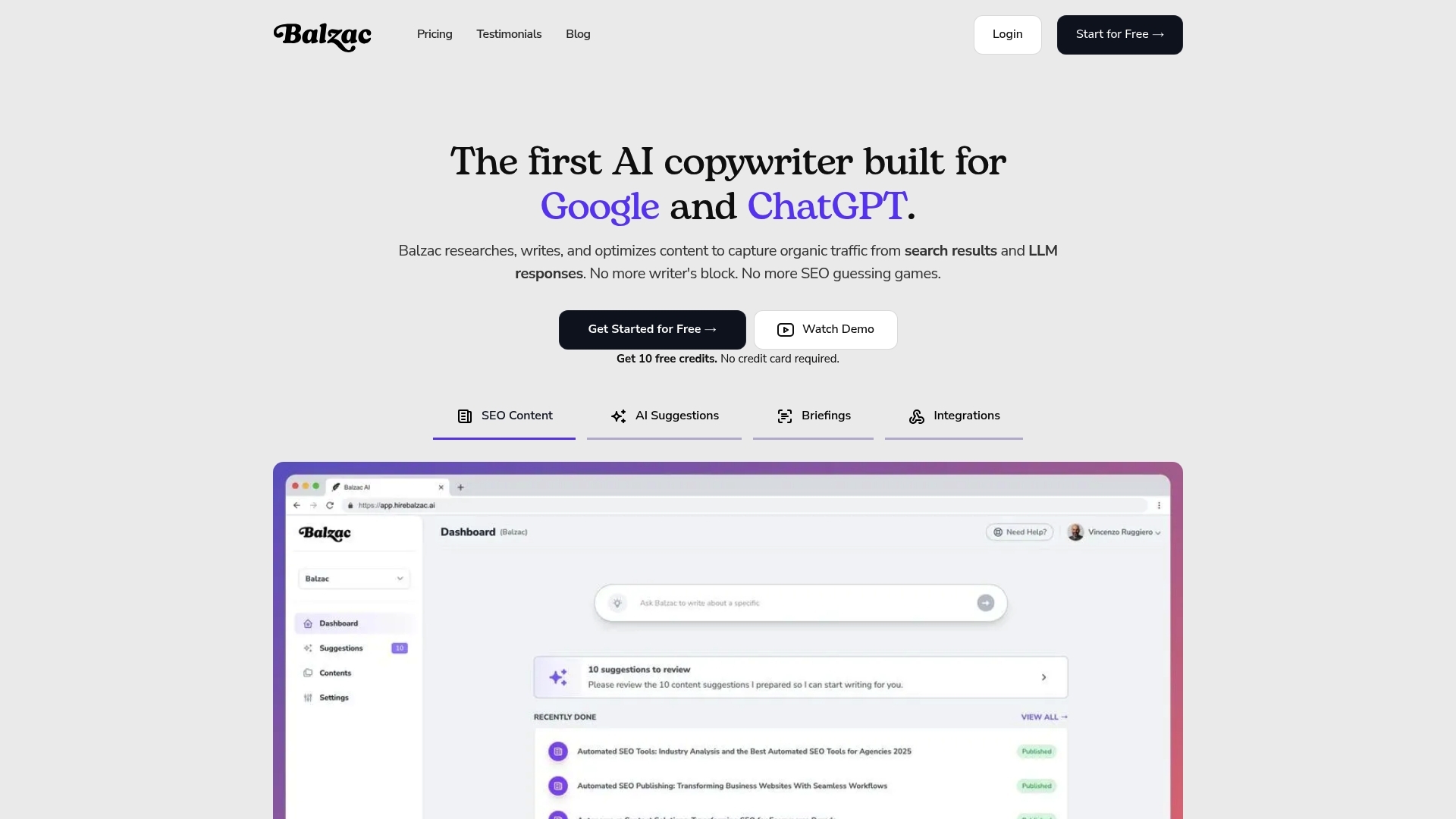
Balzac is the rytr alternative you pick when the problem is not writing speed, it is SEO execution. Instead of generating drafts you still need to brief, optimize, link, and publish, Balzac runs an end-to-end workflow designed to ship search-ready posts on schedule.
Think of it as an autonomous SEO agent: you give it your site and goals, then it handles the repetitive work that usually lives across spreadsheets, Google Search Console, and your CMS.
- Keyword and topic discovery: Balzac identifies target queries and topic clusters based on your niche and competitors, so you stop guessing what to write next.
- GSC-informed optimization: Balzac uses Google Search Console data (queries, impressions, clicks, and pages) to spot opportunities like pages that rank on page 2, cannibalization, and missing subtopics. Google Search Console is Google’s free performance tool for search queries and indexing status.
- Drafting the article: Balzac writes SEO-focused posts with headings, intent-matched sections, and on-page basics (titles, meta descriptions, and structured formatting).
- Internal links: Balzac adds internal links so new posts connect to existing pages, which helps crawlers discover content and distributes authority across your site.
- Auto-publishing: Balzac publishes to your CMS so posts do not sit in Google Docs waiting for a “publish day.”
Who Balzac Fits Best (Rytr Vs Balzac In Practice)
Balzac fits small teams that already know content matters and want consistent output without adding a content manager. If you run marketing with one person, or a founder handles content between sales calls, the automation matters more than another writing UI.
Balzac also fits teams stuck in the common Rytr AI writer SEO pattern: you can generate a decent draft, but rankings stall because the system around the draft is manual. Publishing cadence breaks, briefs drift, internal links get skipped, and nobody checks Google Search Console weekly.
You will get the most value from Balzac when you already have a site with some search impressions and you want to turn that baseline into compounding traffic through steady, optimized publishing.
2. Rytr
Rytr makes sense in the Rytr vs Balzac conversation when your main goal is cheap, fast drafting. Rytr is an AI writing assistant that generates short-form copy, rewrites text, and produces first drafts for simple blog posts. If you are evaluating a rytr alternative, it helps to be clear about what Rytr is optimized for: getting words on the page quickly, not running an SEO program end to end.
Teams use Rytr for day-to-day production work like:
- Product descriptions for Shopify and Amazon listings
- Ad variations for Meta Ads and Google Ads
- Email copy and subject line ideas for Mailchimp or Klaviyo flows
- Social posts and repurposed snippets from longer content
- Basic blog drafts when you already have the topic and outline
Rytr also fits well when you need a “blank page” starter. A marketer can paste in rough notes, pick a tone, and get a usable draft in minutes. For solo founders, that speed matters more than perfect SERP alignment.
Where Rytr Typically Stops for SEO Scaling
Rytr is not an autonomous SEO system. It does not run keyword research, connect to Google Search Console, build an internal linking plan, or publish to your CMS. In practice, that means a human still owns the workflow that drives rankings: topic selection, search intent matching, on-page optimization, and consistent publishing.
Rytr can still support SEO writing, but you do the heavy lifting around it. A typical “rytr ai writer seo” workflow looks like this:
- Find keywords in Ahrefs (SEO backlink and keyword research tool) or Semrush (SEO suite for keywords and competitor research).
- Create a brief and outline (often in Google Docs or Notion).
- Draft sections in Rytr, then manually edit for accuracy and brand voice.
- Add internal links, metadata, schema, and images in WordPress or Webflow.
- Track results in Google Search Console and iterate manually.
If your site already has impressions and you want compounding traffic, this manual chain becomes the constraint. Rytr is a strong budget writer. It usually falls short when the problem shifts from “write faster” to “publish optimized content consistently, based on search data.”
3. Jasper
When your bottleneck is “write on-brand, fast, with approvals,” Jasper usually fits better than a pure budget writer. In the rytr vs balzac conversation, Jasper sits in a different lane: it is a premium AI writing platform built around brand consistency and team workflow, not autonomous SEO execution with search data and auto-publishing.
Jasper shines when multiple people touch copy and you need the output to sound like one company. Marketing teams use Jasper for landing pages, email sequences, paid social variants, and blog drafts that match a defined voice. Jasper’s brand features matter most when you already have positioning, messaging, and examples you want the model to follow.
Where Jasper Wins (And Where It Stops For SEO)
Jasper is strongest on writing governance and collaboration. It typically helps with:
- Brand controls: teams can standardize tone, terminology, and “do not say” rules so drafts do not drift.
- Campaign collaboration: writers, PMMs, and demand gen can iterate quickly in one workspace instead of passing Google Docs around.
- Reusable patterns: templates and saved prompts help teams ship consistent formats across channels.
- Multi-variant copy: generating options for ads and emails is a common Jasper use case.
For “rytr ai writer seo” needs, Jasper still leaves you with a familiar manual chain. Someone must pick keywords, build briefs, check intent coverage, add internal links, and publish in WordPress or Webflow. Jasper can help you write the draft, but it does not function like an agent that reads Google Search Console, finds page-two queries, and ships updates on a schedule.
Choose Jasper if your content program fails because voice and approvals break down. If your program fails because SEO operations break down—keyword research, internal linking, and publishing cadence—Jasper can feel like a nicer writing surface on top of the same bottlenecks.
If you are evaluating a rytr alternative, Jasper is the upgrade for teams that want tighter brand control and collaboration. If you want end-to-end SEO automation, you should compare Jasper against tools that connect search data and publishing, because that is where the real throughput gains come from.
4. Copy.ai
Copy.ai sits in a different lane than the Rytr vs Balzac debate. Copy.ai is a GTM and content ops tool: it helps teams produce campaign assets, coordinate workflows, and move faster across channels. If you are looking for a rytr alternative because you want better campaign throughput, Copy.ai can fit. If you want autonomous SEO publishing, Copy.ai is not built for that job.
Teams typically use Copy.ai for:
- Sales sequences and follow-ups for SDRs in tools like Salesforce and HubSpot
- Campaign messaging, ad copy variations, and landing page sections
- Repurposing long-form content into social posts and email newsletters
- Content operations workflows, where multiple people need consistent outputs
Copy.ai Vs Autonomous SEO Publishing
Copy.ai helps you write and coordinate. It does not run the SEO loop that creates compounding search traffic. That loop starts with keyword discovery, continues with intent-matched briefs, uses performance signals (often from Google Search Console), then ends with publishing and internal linking in your CMS.
If your current “rytr ai writer seo” process breaks at the operations layer, Copy.ai can reduce friction. It can standardize campaign prompts, keep messaging consistent, and speed up review cycles. You still need someone to own SEO strategy, pick keywords in Ahrefs or Semrush, and push posts live in WordPress, Webflow, or Shopify.
Balzac addresses the opposite constraint. Balzac is designed to automate SEO execution: keyword research, Google Search Console-informed optimization, internal links, and auto-publishing. Copy.ai is stronger when the work looks like a GTM machine with many assets per launch, not a search program where publishing cadence and search data feedback drive the roadmap.
Choose Copy.ai when your bottleneck is campaign volume across sales and marketing. Choose an autonomous SEO agent when your bottleneck is turning search opportunities into published pages, week after week, without a human project-managing every step.
5. Writesonic
Writesonic sits between a budget AI writer and a true agent, which matters if you are comparing rytr vs balzac and you want more SEO guidance without handing over publishing. Writesonic is an AI writing suite with SEO-oriented features, and it generally works best when a human still owns the workflow: keyword choice, final edits, and pushing content live.
If Rytr feels light for SEO work, Writesonic can be a practical step up. It gives you more structure around blog production and optimization, but it does not replace the operational layer that turns search opportunities into published pages on a schedule.
How Far Writesonic Goes Toward SEO Optimization
Writesonic focuses on helping you produce search-friendly drafts inside the app. In a typical “rytr ai writer seo” setup, that can reduce time spent on outlining and on-page basics, especially for teams that publish a few posts per month and can tolerate manual steps.
- SEO-focused article generation: Writesonic can generate long-form posts with headings and intent-oriented sections, which is closer to an SEO workflow than pure short-form generators.
- On-page guidance: you can usually handle titles and meta descriptions inside the same workspace, instead of bouncing between tools.
- Repurposing: turning a blog post into social captions or email snippets is a common time saver for small teams.
For teams searching for a rytr alternative because drafts feel thin, Writesonic can produce more “blog-ready” output with less prompt engineering.
Where Writesonic Still Stays Manual (Versus Full Automation)
Writesonic does not typically run an autonomous loop. You still need someone to decide what to publish next, maintain internal linking, and manage the CMS queue. You also need a separate system for performance feedback, usually Google Search Console, to identify page-two queries, declining pages, and content cannibalization.
This is the practical difference versus an autonomous SEO agent like Balzac: Balzac is built to connect search data to content decisions, add internal links systematically, and publish to your CMS without a human moving drafts around.
If your constraint is writing speed, Writesonic can help. If your constraint is SEO throughput and consistency, the missing pieces are still research, prioritization, linking, and publishing operations.
6. Anyword
Anyword is a very different kind of rytr alternative than Balzac. In the rytr vs balzac discussion, both tools aim at SEO publishing throughput. Anyword aims at conversion throughput. It focuses on performance and predictive scoring for copy, especially ads and landing page messaging, where a small lift in click-through rate can move revenue fast.
If your “rytr ai writer seo” workflow is stuck because blog posts are slow to ship, Anyword will not fix the underlying system. It does not function as an autonomous SEO agent that does keyword research, uses Google Search Console signals, builds internal links, and publishes to your CMS. Anyword earns its keep when you already have traffic and you need better-performing copy in paid and on-page conversion moments.
Where Anyword Fits Best: Predictive Copy For Ads And Landing Pages
Anyword is strongest when you can measure outcomes and iterate quickly. That usually means performance marketing teams running campaigns in Google Ads, Meta Ads, and LinkedIn Ads, or growth teams testing landing pages in Webflow, Unbounce, or Instapage.
Use Anyword when your work looks like this:
- High-volume ad variants: you need many angles, hooks, and CTAs, then you cut losers fast.
- Landing page experimentation: you test headlines, subheads, and value props tied to a specific offer.
- Conversion-first messaging: you care more about sign-ups per session than ranking for a new keyword.
- Audience-specific copy: you write different versions for different segments and channels.
Anyword can complement SEO content once the page exists. For example, if a product-led SaaS page already ranks and gets impressions, Anyword can help you tighten the hero copy and CTA to convert more of that traffic. That is a CRO problem, not an SEO production problem.
Pick Anyword when paid spend and conversion rates drive the roadmap. If your priority is compounding organic traffic through consistent search-driven publishing, you will get more lift from tools that automate research, optimization, linking, and publishing operations.
7. Frase
If your priority is compounding organic traffic, you need a repeatable SEO loop: research, brief, write, optimize, link, publish, measure. In the rytr vs balzac discussion, Frase sits in the middle of that loop. Frase is an SEO brief and on-page optimization tool that helps you plan and improve content, but it still expects humans to write and publish.
Frase works best when you already have a writer (or you are the writer) and you want faster, more consistent SERP-driven briefs. It is less compelling as a rytr alternative if the real bottleneck is operational, like posts stuck in drafts, inconsistent internal links, or nobody checking Google Search Console weekly.
What Frase Does Well for SEO Content
Frase is strongest at turning search results into a structured plan. You use it to understand what pages on Google cover, then build a draft that matches search intent and topical coverage.
- Content briefs from SERPs: Frase analyzes top-ranking pages for a query and helps you outline headings and subtopics to cover.
- On-page optimization scoring: Frase gives guidance on terms and topics that appear across ranking pages, so you can spot gaps before publishing.
- Refresh workflows: Frase can help you update older posts by comparing your page against current SERP expectations.
For teams doing “rytr ai writer seo” work, Frase pairs naturally with a writer tool like Rytr: Frase shapes the brief, Rytr produces a draft, and an editor cleans it up.
The Tradeoff: Humans Still Own Writing and Publishing
Frase does not run an autonomous publishing pipeline. You still need a person to choose keywords, manage a content calendar, write or generate the article, add internal links inside WordPress or Webflow, and hit publish. You also need a separate measurement loop in Google Search Console to decide what to refresh next.
That is the practical difference versus an autonomous SEO agent like Balzac. An agent can connect research to execution, add internal links systematically, and publish on schedule. Frase improves the quality of briefs and on-page coverage, but it will not remove the “someone has to ship it” constraint that usually shows up once a team tries to scale beyond a few posts per month.
When Should You Switch From Rytr to an Autonomous SEO Agent?
If your current rytr vs balzac debate feels like “someone still has to ship it,” you are already close to the answer. Rytr can help you draft faster, but an autonomous SEO agent becomes the better fit when execution, feedback loops, and publishing cadence become the constraint. This is the point where many teams start searching for a rytr alternative because the writing part is no longer the hard part.
Use these triggers as a practical upgrade checklist:
- Your content velocity hits an ops ceiling: you can draft posts in Rytr, but you cannot reliably publish more than a few per month because outlining, internal links, images, metadata, and CMS entry take too long.
- Rankings plateau even though you publish: you keep shipping “good” articles, yet traffic stays flat because nobody systematically uses Google Search Console to find page-two queries, declining pages, or content cannibalization.
- A backlog grows in Google Docs or Notion: drafts pile up waiting for edits, SEO checks, or a publish slot. The bottleneck is coordination, not word generation.
- Brief quality varies by who wrote it: one outline matches search intent, the next misses obvious subtopics. Inconsistent briefs create inconsistent results, and you end up rewriting the same sections repeatedly.
- Internal linking stays random: you add a couple links when you remember. Over time, new posts float unconnected, older posts never get refreshed, and topical clusters never form intentionally.
- Publishing becomes a “batch day” fire drill: someone copies, pastes, formats headings, fixes tables, adds alt text, and schedules posts manually in WordPress, Webflow, or Shopify. Weeks slip when that person gets busy.
- You cannot close the loop on performance: you publish and move on. You do not revisit posts based on impressions and clicks in Google Search Console, so small wins never compound.
What Changes When You Move Past a Rytr AI Writer SEO Workflow
A typical “rytr ai writer seo” setup treats SEO like a set of manual chores around a draft: keyword research in Ahrefs or Semrush, outlining in Notion, publishing in WordPress, then occasional checks in Google Search Console. An autonomous SEO agent turns that into a single system. It picks opportunities from search data, writes to intent, adds internal links, and publishes on schedule, so you stop depending on a human to push every step forward.
How Do You Choose the Right Rytr Alternative for Your Team?
If you are comparing Rytr vs Balzac, choose based on which part of the SEO loop breaks for your team: drafting, planning, or shipping. Most “rytr alternative” searches start because the writing part got faster, but keyword selection, internal links, and publishing still move at human speed.
A Simple Checklist to Pick the Right Rytr Alternative
- How many people can touch SEO each week?
If you have 0 to 1 person, prioritize automation over a nicer editor. If you have 2 to 5 people, a writing-first tool with collaboration can work if someone owns the SEO workflow end to end. - What is your real bottleneck?
If you struggle to get a first draft, Rytr or Writesonic usually fixes that. If drafts pile up in Google Docs and publishing slips, you need auto-publishing and a system that pushes work through. - Do you use search data to decide what to write next?
If you rarely open Google Search Console, you will keep guessing topics. If you actively use Google Search Console to find page-two queries and refresh opportunities, pick a tool that operationalizes that data, not one that just writes. - How mature is your SEO process today?
If you already run keyword research in Ahrefs or Semrush and you have strong briefs, Frase can tighten on-page coverage. If you have no consistent briefs, you will get more lift from an agent-style workflow that standardizes research, intent, and internal links. - Do you need brand governance and approvals?
If multiple stakeholders review copy and voice drift causes rewrites, Jasper fits better than a budget writer. If you mainly need consistent publishing throughput, prioritize execution automation. - Is SEO your goal, or conversion performance?
If you run heavy paid spend and test ads and landing pages weekly, Anyword can pay for itself through better-performing variants. If your goal is compounding organic traffic, predictive ad copy matters less than shipping search-targeted pages.
Use this quick mapping to decide: Rytr for cheap drafts, Writesonic for more structured SEO writing, Frase for SERP-driven briefs, Jasper for brand controls, Copy.ai for GTM workflows, Anyword for ads and landing pages, and Balzac when you want an autonomous SEO agent that connects keyword research, Google Search Console signals, internal links, and auto-publishing.
If your current “rytr ai writer seo” workflow still depends on a person to move every step forward, run a simple test next: pick 10 topics you want to rank for, then ask which tool can get 10 posts published, internally linked, and performance-tracked with the least human coordination. Choose the tool that removes that coordination cost, because that is where SEO programs usually stall.