
Most teams don’t quit LongShot AI because the writing is bad. They quit because the “easy part” ends after the draft, and someone still has to do the research, shape the SEO angle, clean up the piece, and push it into the CMS—every week.
That’s the real LongShot AI vs Balzac decision. LongShot AI is an assistant you drive: it helps you move faster once you’ve picked the topic and steered the outline. Balzac is built for the opposite constraint: you set guardrails and approvals, then it runs the research-to-publish loop with far less manual coordination.
This guide is for marketers hunting a longshot alternative because time is the bottleneck. You’ll see where each tool fits in a real workflow, when a human-led drafting setup is the right call, and why teams that need consistent SEO output usually end up preferring automation over another place to paste prompts.
What Is the Real Difference Between LongShot AI and Balzac?
Approvals and brand voice are human problems. Content volume and consistency are workflow problems. The LongShot AI vs Balzac choice comes down to which problem you need to solve, because the tools sit in different categories.
LongShot AI is a research and writing assistant. You use it to generate ideas, outline, draft sections, rewrite paragraphs, and pull supporting context for a piece you still manage. It helps you move faster inside a human-led process.
Balzac is an autonomous SEO agent. You give it your site details and constraints, then it runs the research-to-publish loop with minimal involvement. That difference in “who drives” the workflow explains most of the practical differences people feel when they try a longshot alternative.
LongShot AI Content Workflow vs Autonomous SEO Loop
Here is the simplest way to think about it. LongShot AI content typically follows a manual sequence where a marketer stays in the driver’s seat. Balzac follows an automated sequence where the system does the driving and the marketer sets guardrails.
- With LongShot AI: you pick the topic, decide the angle, request research, generate drafts, edit for accuracy and voice, add internal links, format for your CMS, then publish.
- With Balzac: you set the site, audience, and publishing rules, then the agent handles topic discovery, competitor-informed research, SEO-focused writing, and CMS publishing on a schedule.
If you have ever used Surfer SEO (a content optimization tool) or Clearscope (a content grading platform), LongShot AI fits that general “assist the writer” pattern, even if the interface and features differ. Balzac fits the “agent” pattern that aims to remove the writer from the loop for routine SEO pages.
The autonomy gap matters because it changes what you spend time on. With an assistant, you spend time producing and refining each article. With an autonomous agent, you spend time defining what “good” means for your site, then reviewing exceptions.
The same gap also changes failure modes. LongShot AI can stall if you do not have a clear brief, because it waits for direction. An autonomous agent can publish the wrong thing if your guardrails are vague, because it keeps moving.
In practice, teams that search for a longshot alternative usually want one of two outcomes:
- Better drafts per hour: choose an assistant style tool and keep human editorial control tight.
- More pages per week: choose an autonomous loop that can research, write, and publish consistently.
If you want a neutral frame for evaluating “assistant vs agent” systems, Google’s documentation on how automated content can still be helpful when it serves users is a solid reference point. See Google Search Central: Creating Helpful, Reliable, People-First Content.
So when you ask “what is the real difference,” it is this: LongShot AI helps a marketer create content faster, while Balzac aims to run the full SEO content loop autonomously. That is why the two products can feel similar in demos but behave very differently after week two.
1. Balzac
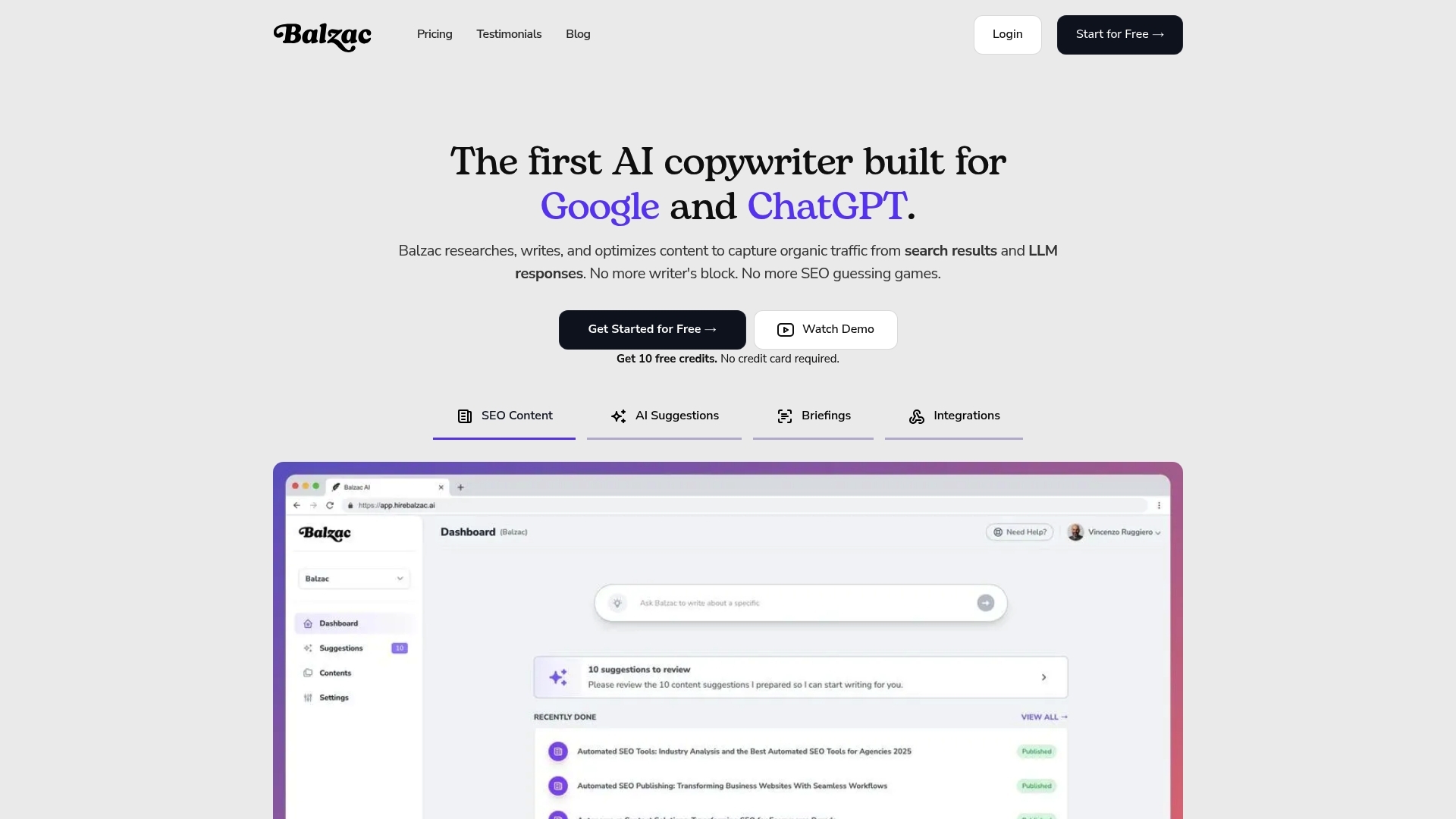
Balzac is the longshot alternative you pick when “week two” is where your workflow breaks. If your team keeps stalling after the demo because someone still has to research, outline, draft, optimize, and publish, Balzac targets that exact gap. It behaves less like a writing assistant and more like an autonomous SEO agent that can run content production end-to-end.
In the LongShot AI vs Balzac comparison, Balzac’s headline advantage is delegation. You give it your site context and guardrails, then it handles topic discovery, competitor-informed research, SEO writing, and publishing to common CMS setups with minimal human work.
What Balzac Automates From Research to Publish
Balzac focuses on the steps marketers usually do across five different tools. The point is simple: reduce the number of handoffs where quality drops and deadlines slip.
- Topic discovery and prioritization: Balzac can generate topic ideas based on what your site should rank for, instead of waiting for a human to brainstorm a list.
- Competitor analysis for direction: It uses competitor context to inform what to cover and what angles matter for search intent, so you stop guessing based on “best practices.”
- SEO-optimized drafting: Balzac writes the article as part of the same loop, with SEO structure baked in rather than added after the fact.
- Publishing to major CMS platforms: Balzac can publish automatically, which removes the copy-paste step that often delays shipping content for days.
- Always-on operation: Balzac can keep producing on a schedule, which matters when consistency is your main SEO constraint.
This is why Balzac feels different from LongShot AI content workflows. LongShot AI helps you write faster. Balzac aims to remove the need for you to run the workflow at all.
If you want a practical mental model, think of Balzac as replacing a chain that often includes Google Search, Ahrefs (an SEO backlink and keyword research tool), Google Docs, Surfer SEO (a content optimization tool), and a WordPress editor. Balzac compresses that chain into one system with fewer manual steps.
Best-Fit Use Cases (And When to Skip It)
Balzac fits teams that measure success in published, indexable pages per week, not in how quickly someone can draft a paragraph.
- Lean marketing teams: A founder, a marketer, or a small team that cannot justify hiring writers or an agency for consistent output.
- SEO programs built on velocity: Companies building topical coverage across many queries, where the backlog is huge and the bottleneck is production time.
- Teams that want predictable operations: If you want content to ship on a schedule with lightweight review, automation beats “we will get to it.”
Skip Balzac if your constraints are mostly editorial, legal, or brand governance. If every post needs multiple rounds of approvals, custom SME interviews, or strict brand tone reviews, you may prefer a tool like LongShot AI where humans stay in the driver’s seat and the AI supports drafting and research.
Balzac works best when you can define guardrails once, then let the system execute repeatedly. That is the whole point of choosing an autonomous longshot alternative instead of another assistant.
2. LongShot AI
LongShot AI makes sense as a longshot alternative when you want help producing drafts faster, but you still want to run the process yourself. It behaves like a well-stocked writing room: prompts, templates, rewrites, and research support, then you decide what to keep, what to verify, and what to publish.
This is the core trade in LongShot AI vs Balzac. LongShot AI speeds up the parts of writing that feel slow, while leaving the workflow ownership with the marketer. If you already have a content strategy, a keyword list, and an editor who can QA facts and tone, LongShot AI content can fit cleanly.
Where LongShot AI Content Shines
LongShot AI is strongest when you treat it as an assistant inside a human-led SEO workflow. You bring the topic and constraints, then use LongShot AI to get to a usable first draft faster.
- Ideation and angles: generating topic variations, hooks, and outlines when you have a keyword but no clear narrative.
- Draft acceleration: producing section drafts, intros, and rewrites you can stitch into a final article.
- Research support: summarizing sources you provide, turning notes into paragraphs, and creating FAQ-style blocks for common queries.
- Repurposing: rewriting a blog post into LinkedIn copy, email snippets, or short social captions.
In practice, LongShot AI works best for marketers who already know their product and audience. If you can write a solid brief, you can get a solid draft quickly. If your brief is vague, the output usually looks generic, because the tool waits for direction.
LongShot AI also fits teams that need tight brand control. When legal, compliance, or a brand editor must approve every claim, an assistant that hands you editable text is often easier to govern than a system that publishes on its own.
Where Manual Work Still Stacks Up
LongShot AI does not remove the operational load that eats most content time. You still own the inputs and the finish line, and that is where many teams feel the drag.
- Keyword strategy and prioritization: you still choose targets, map intent, and decide what to publish next.
- Competitor-informed research: you still need to review top-ranking pages, extract gaps, and set a differentiated angle.
- Fact checking and citations: you still verify claims, update stats, and add trustworthy sources.
- On-page SEO and internal linking: you still add links, optimize headings, and align the piece with your site architecture.
- CMS formatting and publishing: you typically still copy, paste, format, add images, and hit publish.
If your goal is to delegate the entire research-to-publish loop, that is where LongShot AI content workflows can feel incomplete. You can ship good articles with LongShot AI, but you will ship them because your team keeps the machine moving.
For a quality bar reference, Google’s guidance on “helpful, reliable, people-first content” is worth reading before you scale any AI-assisted workflow: Google Search Central: Creating Helpful, Reliable, People-First Content.
3. Jasper
Google’s “people-first” bar is easier to hit when a human owns the voice. Jasper is a strong longshot alternative for teams that want AI speed inside a tightly controlled brand workflow, where humans still decide the SEO plan and handle publishing.
In practice, Jasper sits closer to LongShot AI than to Balzac. If your main question is LongShot AI vs Balzac, Jasper belongs on the LongShot side of the spectrum: it helps you draft faster, but it does not run an autonomous research-to-publish loop. That makes Jasper a good fit when your bottleneck is writing time, not operational throughput.
Why Jasper Works When Brand Control Matters
Jasper’s best use case is brand-led content production: you already know what you want to publish, you want it to sound like your company, and you want to move from blank page to solid draft quickly. Jasper’s “Brand Voice” feature (trained on your examples) and its campaign-oriented workflows tend to suit marketing teams producing landing pages, email sequences, paid social copy, and blog drafts that need consistent tone.
Jasper also offers built-in collaboration features geared toward teams, plus extensions like Jasper’s browser extension for rewriting and drafting across web apps. For organizations that live in Google Docs, Notion, or a CMS editor, that matters more than another research widget.
If you evaluate Jasper as a longshot AI content replacement, judge it on how well it helps your team ship on-brand drafts and iterate faster during reviews, not on whether it can independently pick topics or publish posts.
Jasper can pair well with SEO and content tools you may already use, such as:
- Ahrefs, an SEO keyword and backlink research tool, for keyword discovery and competitor research.
- Semrush, an SEO suite with keyword research and content planning, for building topic clusters.
- Surfer SEO or Clearscope, content optimization tools, for on-page guidance and content grading.
This stack keeps humans accountable for intent, internal linking, and claims. Jasper speeds up drafting and rewrites within that system.
Where Manual Work Still Stacks Up
Jasper does not remove the heavy lifting that makes SEO programs succeed. Someone still needs to pick targets, validate search intent, decide what to include, and QA accuracy. Someone still needs to format and publish in WordPress, Webflow, HubSpot, or another CMS, then monitor performance in Google Search Console and Google Analytics 4.
This is the core tradeoff versus an autonomous agent. Jasper helps you produce better drafts per hour, but it does not replace the operational loop. If your team keeps missing publishing cadence because research, SEO decisions, and CMS work pile up, Jasper will not solve that bottleneck by itself.
Pick Jasper when you want brand-controlled drafting with team workflows. If you want full delegation from research through publishing, Jasper is the wrong category, and an autonomous option like Balzac fits the job better.
How to Choose the Right Longshot Alternative for Your Team
Most teams shopping for a longshot alternative fail for one reason: they pick a tool category that does not match their constraint. If your constraint is governance (approvals, brand voice, legal), you want a human-led drafting workflow. If your constraint is throughput (research, writing, posting every week), you want automation that can publish.
- Measure your available time per article. If you can reliably spend 2 to 4 hours per post on research, editing, and CMS work, LongShot AI or Jasper can fit. If you cannot protect that time each week, prioritize an autonomous option like Balzac that runs the loop and leaves you with review.
- Set your quality bar in one sentence. If “must sound exactly like our brand” is the bar, Jasper usually fits better than LongShot AI because it is built for team workflows and brand control. If “must ship consistent, search-intent pages on schedule” is the bar, Balzac fits better than assistant tools.
- Count your approval steps. Map the real path from draft to publish. If every post needs approval from legal, product, and a brand editor, autonomous publishing creates risk unless you can gate publishing. If one person can review and approve quickly, automation pays off fast.
- Decide who owns SEO strategy. Many LongShot AI content setups still require a human to pick keywords, check competitors, decide the angle, and manage internal links. If you already run SEO in Ahrefs (SEO keyword and backlink research) or Semrush (SEO suite for keyword research and competitive analysis) and you want AI to draft inside that strategy, assistant tools work. If you want the system to propose topics and execute consistently, pick an autonomous agent.
- List the integrations you will actually use. Write down your CMS (WordPress, Webflow, Shopify, Ghost) and your analytics stack (Google Analytics 4, Google Search Console). If your process breaks at the “copy, paste, format, upload images, schedule” step, require autopublish. If your process breaks at “we cannot get a first draft,” require strong drafting and collaboration features.
- Be honest about risk tolerance for autopublish. Autopublish is the biggest operational unlock and the biggest governance question. If you can define guardrails and accept light review, autopublish removes days of delay. If you cannot accept any publishing mistakes, keep publishing manual and optimize the drafting stage.
Quick Chooser For LongShot AI vs Balzac Scenarios
Use these scenarios when the LongShot AI vs Balzac comparison still feels abstract:
- Pick Balzac when you want full delegation from topic research through CMS publishing, and you can review outputs quickly or approve by exception.
- Pick LongShot AI when you want help drafting and summarizing research, and you already have a human-run SEO workflow that you trust.
- Pick Jasper when multiple people touch content, you need brand consistency across writers, and you want collaboration and approvals around the draft stage.
If you want one external standard for what “good” looks like before you scale production, use Google Search Central: Creating Helpful, Reliable, People-First Content as your QA checklist. It keeps the decision grounded in outcomes, not features.
Which Tool Wins for Fully Automated SEO Content in 2026?
Google Search Central’s “helpful, reliable, people-first” checklist is the right yardstick for AI content in 2026. Once you adopt that standard, the winner for fully automated output becomes clearer: you need a system that can research, write, and publish consistently without creating a new management job. That is why most teams comparing a longshot alternative end up choosing an autonomous agent over a drafting assistant.
Here is the direct answer: Balzac wins for fully automated SEO content. LongShot AI and Jasper can help you write faster, but they still depend on you to run the loop. If your goal is “set guardrails, ship pages,” autonomy decides the outcome.
LongShot AI vs Balzac: Who Wins by Scenario?
Solo creator (high taste, limited time): If you publish occasionally and you enjoy shaping voice, LongShot AI can be a better fit. LongShot AI content works when you already know what you want to say and you want a faster first draft. You still do the keyword picking, SERP review, internal links, and CMS publishing. If those steps feel like the work, you will still feel the work.
Solo creator (needs cadence, hates ops): If your main constraint is shipping every week, Balzac is the safer choice. You can review drafts and spot-check facts, but you stop spending nights formatting in WordPress or copying headings into Webflow. This is the scenario where “assistant” tools disappoint, because the bottleneck lives outside the text box.
Marketing team (pipeline and accountability matter): Balzac usually wins because it behaves like a production system. Teams care about predictable throughput: topic selection, competitor-informed research, drafts that match intent, then publishing on schedule. LongShot AI and Jasper still require a human owner for each step, which turns into a queue when people get busy.
Marketing team (strict brand and legal review): Jasper often fits best for brand-controlled drafting, especially if you already run approvals in Google Docs or Notion. LongShot AI can also work here. In this scenario, full automation can create friction because governance, compliance, or SME review sets the pace. You can still use Balzac, but you should configure it for review-first publishing and tighter guardrails.
Agency or multi-client setup: Jasper’s collaboration and brand voice features can help you manage multiple tones. Balzac fits when clients buy output volume and you can standardize guardrails per site. LongShot AI fits when each client expects custom positioning and heavy human editing.
If speed matters, pick the tool that removes the most steps. In the LongShot AI vs Balzac decision, that usually means choosing the autonomous loop, because research, SEO decisions, and publishing consume more hours than drafting paragraphs.
A practical next step: take one keyword cluster you already care about, then run a two-week test where you measure pages published and time spent per page. If you want full delegation, choose Balzac and review outputs against Google’s people-first criteria. If you want hands-on control, choose LongShot AI or Jasper and measure how often the process stalls before publish.