
An AI writing assistant for business content automates the work between a keyword idea and a published, search ready page. It turns SEO from a slow, manual process into a repeatable system that ships content on a set cadence.
In practical terms, it helps you research topics, create outlines, draft pages, optimize on page SEO (headings, intent match, internal links), and push content into your CMS for review or publishing. Some tools also monitor competitors, suggest new keywords, and keep content consistent with a defined brand voice.
What This Means for a Business Website
- More coverage: you publish more pages that target more searches.
- More consistency: you keep a steady publishing schedule without relying on writer availability.
- Faster cycles: you shorten the path from idea to live page.
Tools vary from “assistants” that draft text to autonomous agents. For example, Balzac focuses on end to end SEO content automation, including generation and automatic publishing, with controls for topics, quality, and timing.
What Is an AI Writing Assistant for Business Content Automation?
An AI writing assistant for business content automation is software that helps a team plan, write, optimize, and ship content at scale. In business terms, it reduces the manual work of turning a keyword or topic into a publish ready page, while keeping quality and SEO requirements consistent.
Most tools use large language models to draft text, but the business value comes from the workflow around the draft. A useful assistant supports repeatable inputs (keywords, audience, product details), repeatable outputs (briefs, outlines, pages), and repeatable checks (SEO, links, tone, compliance).
What “Content Automation” Means in Practice
Content automation means the system runs parts of the content lifecycle with minimal human effort. It goes beyond rewriting text. It automates the steps that usually slow teams down, such as picking topics, creating briefs, applying on page SEO, and publishing on schedule.
- For SEO: it creates pages that target specific queries, adds headings and structure, and helps keep internal linking consistent.
- For teams: it reduces bottlenecks across marketing, SEO, and subject matter experts by standardizing briefs and outputs.
- For workflows: it connects research, writing, review, and publishing in one repeatable process.
What an AI Writing Assistant Is (And Is Not)
An AI writing assistant is a content production tool, it supports drafting and optimization. It is not a full SEO strategy by itself, and it does not replace brand knowledge or legal accountability. Your team still sets goals, approves claims, and decides what should rank.
Common examples include ChatGPT (OpenAI) for drafting, Jasper for brand voice, and Grammarly for editing. An autonomous SEO agent like Balzac focuses more on end to end automation, including generating SEO focused articles and publishing to CMS platforms, with controls for topics and cadence.
Where AI Fits Inside Existing Marketing Stacks
Businesses often pair AI writing tools with SEO platforms like Ahrefs or Semrush, and with CMS platforms like WordPress. Google’s helpful content guidance stays the baseline: publish content for people first, then optimize for search.
How Does an AI Writing Assistant Workflow Work (From Keyword to Published Page)?
An AI writing assistant workflow starts with a search query and ends with a live page in your CMS. The best setups keep each step explicit so teams can control quality, voice, and publishing cadence.
End to End Workflow From Keyword to Published Page
- Keyword and intent research: You pick a target keyword, confirm intent (informational, commercial, transactional), and identify close variants. Many teams pull ideas from Google Search Console and competitor pages, then map one primary keyword per page.
- SERP and competitor review: The system checks what ranks now, common headings, content length ranges, and missing angles. This step prevents writing pages that ignore what Google already rewards.
- Outline creation: The assistant generates an outline with H2 and H3 sections that match intent and include supporting subtopics. You can lock required sections, such as pricing, use cases, or compliance notes.
- Draft generation: The tool writes the first draft in your brand voice, using your product details, approved claims, and internal terminology. If you provide sources, it can quote and summarize them.
- On page SEO optimization: The assistant rewrites titles and meta descriptions, improves heading structure, adds FAQs if relevant, and checks for keyword stuffing. It also improves readability by tightening sentences and removing repetition.
- Internal links and entities: The assistant adds links to related pages and anchors that describe the destination clearly. It also references real entities and tools where useful, such as Google Search Console and WordPress.
- Review and approvals: A human or editor checks factual accuracy, tone, and compliance, then approves or requests edits. Some teams enforce a two step review for regulated topics.
- Scheduling or auto publishing: The system pushes the content into the CMS with formatting, featured image prompts, and categories, then publishes on a schedule. Tools like Balzac can run this step autonomously, while still letting you set topic boundaries and timing.
Why Do Businesses Use AI Writing Assistants for SEO (Cost, Consistency, Scale)?
Businesses use AI writing assistants for SEO because they reduce the time and labor between a keyword and a live page. The commercial value comes from three outcomes: lower cost per page, consistent publishing, and more SEO coverage across the topics customers search.
Cost: Lower Content Cost Per Page
Manual SEO writing often includes research, outlining, writing, editing, optimization, and uploading. That work spreads across writers, editors, and SEO leads. An AI writing assistant compresses that effort by generating structured drafts and applying repeatable SEO checks. Many teams use AI to keep humans focused on review and accuracy instead of first drafts.
Cost savings show up as fewer billable hours and less vendor spend, but also as less rework, because the tool starts from an SEO aligned outline and consistent formatting.
Consistency: Publish on a Cadence Without Bottlenecks
SEO rewards sites that cover topics steadily. Teams miss schedules because of hiring gaps, shifting priorities, and slow approvals. A good assistant makes output predictable by standardizing briefs, headings, and on page structure. That consistency helps you avoid content debt, meaning weeks where nothing ships and rankings stall.
Tools that support review workflows also reduce risk by letting your team approve claims before publishing. Google still expects helpful, people first content, even if you use AI to draft it.
Scale: Expand Keyword Coverage Faster
Scale means you publish more pages that match real search intent. With automation, teams can cover:
- Long tail queries that writers ignore because they feel too small
- Product led questions (comparisons, integrations, setup guides)
- Support driven topics that reduce tickets (how to, troubleshooting)
An autonomous agent like Balzac pushes scale further by handling generation and publishing on a schedule, with controls for topics, cadence, and quality checks, so the site keeps shipping even when the team stays busy.
What Should You Look for in the Best AI Writing Assistant for Businesses?
The best AI writing assistant for a business gives you repeatable quality at scale, not just fast drafts. You want clear controls, visible SEO checks, and a workflow that fits your team and risk level.
Quality Controls That Prevent Bad Pages
Quality controls matter because AI can write confident mistakes. Look for tools that support reviewable inputs and enforce checks before publishing.
- Fact and claim handling: supports citations or source grounded writing, and flags unsupported claims.
- Edit and approval flow: draft, revise, approve, publish, with role based access.
- Consistency checks: terminology, product naming, and style rules stay stable across authors and time.
SEO Features That Map to Rankings Work
A strong assistant supports the work Google rewards: intent match, structure, and internal relevance. It should help you follow Google guidance on helpful, people first content.
- Keyword and intent alignment: one page, one main query, with close variants handled naturally.
- SERP informed outlines: headings reflect what currently ranks, without copying competitor text.
- On page SEO outputs: titles, meta descriptions, schema friendly FAQs where relevant, clean heading hierarchy.
- Internal linking support: suggests related pages and anchors that describe the destination clearly.
Brand Voice and Domain Knowledge
Good tools let you encode how you speak and what you can claim. You should be able to add style rules, do and do not lists, product facts, and approved positioning.
Integrations and Publishing
Integration determines whether content ships or stalls. Check for CMS support (for example, WordPress), scheduling, and the ability to push formatted HTML. Balzac matters here if you want autonomous generation and publishing with topic boundaries and cadence controls.
Compliance, Security, and Governance
- Data handling: clear terms on storage, model training, and retention.
- Auditability: who changed what, and when.
- Plagiarism controls: processes that reduce copying risk (many teams also run Copyscape).
How Balzac Automates SEO Content End to End
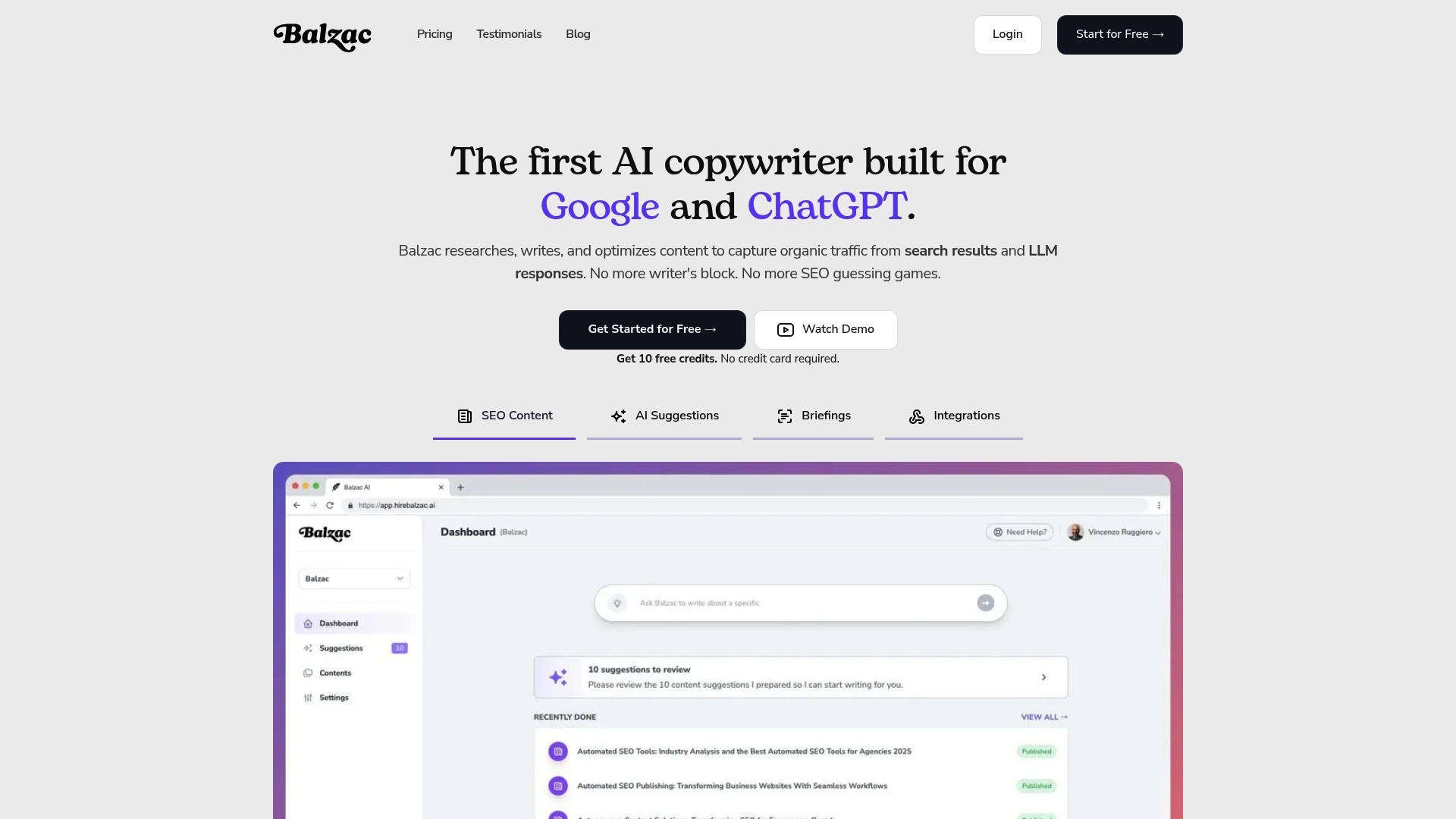
Balzac automates SEO content end to end by running the loop from topic selection to CMS publishing with minimal human input. You set boundaries and cadence, Balzac handles repeatable execution so content still ships when your team is busy.
How Balzac Runs From Topic to Live Page
Balzac starts by turning a topic list or keyword targets into publishable pages. It focuses on search intent and on page structure so each draft matches what readers expect from the query.
- Topic sourcing: You can feed Balzac your priorities (products, locations, use cases) and it can also pull ideas from competitor pages to expand coverage.
- Draft creation: It generates an outline, then writes the article with clear headings and scannable sections.
- SEO packaging: It prepares titles, meta descriptions, and FAQ style sections when they fit the intent, and it adds internal linking suggestions based on your existing site structure.
Controls for Topics, Quality, and Brand Voice
Autopublishing only works if you can control what goes live. Balzac supports topic guardrails so you can block sensitive categories, require specific sections (like pricing notes or compliance statements), and keep terminology consistent with your product.
For quality, teams typically use a simple rule: humans approve claims, the agent handles formatting and SEO checks. This aligns with Google guidance on creating helpful content that serves users first, even when AI helps draft it. (See Google Search Central.)
Cadence and Automatic Publishing
Balzac can publish on a schedule you choose, for example a fixed number of posts per week, or a queue that drains daily. Cadence matters because SEO coverage grows through steady output, not one time bursts.
- Scheduled publishing: You pick timing, categories, and other CMS fields.
- Review optionality: You can route posts for approval first, or allow auto publishing for low risk topics.
- CMS delivery: Balzac publishes to major CMS platforms, so drafts do not get stuck in docs or tickets.
FAQ: AI Writing Assistant for Business Content Automation
If you want consistent SEO output, treat an AI writing assistant as a controlled production system, not a magic writer. You set topics, claims, and review rules, the tool handles the repeatable work.
How Much Does an AI Writing Assistant Cost?
Pricing depends on volume, workflow, and publishing features. Most tools charge a monthly subscription and some add usage based fees. Your real metric is cost per published page, including review time. Many businesses compare AI tooling costs against freelancer or agency rates, plus the time spent managing them.
Will AI Content Trigger Plagiarism Issues?
AI can still create risky overlap if you prompt it to mirror competitors or reuse internal material. You reduce risk when you enforce original structure and wording, avoid copying competitor sections, and run checks with tools like Copyscape. For SEO, follow Google guidance on creating helpful content that adds value instead of rewriting what already ranks, see Google Search Central.
How Accurate Is AI Written Business Content?
Accuracy varies by topic. AI performs best on stable, well documented subjects, and it performs worst on fast changing details such as pricing, legal claims, and product specs. Use a human approval step for facts and keep a single source of truth for product messaging.
Can an AI Writing Assistant Match Brand Voice?
Yes, if you provide explicit rules. You get better results when you define:
- Do and do not language (words to use, words to avoid)
- Approved product descriptions and differentiators
- Formatting rules (headings, CTA style, reading level)
Do You Still Need Approvals and Editors?
Most businesses keep approvals for anything that touches revenue, compliance, or reputation. A common pattern is AI drafts, then an editor checks claims and internal links, then a final approver signs off before publishing.
Is It Safe to Put Company Data Into These Tools?
Ask about data retention, who can access drafts, and whether the provider uses your content for training. Keep sensitive data out of prompts and store approved facts in controlled docs. For general AI privacy guidance, review FTC guidance on AI claims.
How Do You Start Without Breaking Your SEO?
Start with low risk pages such as glossary terms, feature explainers, and support style how to content. Then scale. If you want autonomous generation plus scheduled publishing with topic boundaries, an agent like Balzac fits teams that prefer a set the rules and ship consistently workflow.