
AI SEO changes digital marketing because it shifts SEO from a manual production line to a system that runs with continuous automation. Search no longer rewards teams that publish once a month and hope for rankings. It rewards teams that ship useful pages fast, match real intent, and update content as competitors and search results change.
Generative AI pushes this shift because it lowers the cost of drafting, optimizing, and refreshing content. That creates a new baseline: more pages, tighter topic coverage, and faster iteration. Brands that keep SEO trapped in long briefs, writer queues, and slow approvals fall behind even if their strategy is sound.
What Actually Changes for Brands
The change is not “AI writes blogs.” The change is how brands plan, produce, and publish at scale:
- Planning: topic selection moves from quarterly guesses to data driven, frequent decisions.
- Production: drafts, metadata, and on page SEO happen in hours, not weeks.
- Publishing: workflows connect directly to CMS tools like WordPress.
- Iteration: content updates become routine, not rare.
This is where autonomous agents like Balzac fit: they handle repeatable SEO work end to end, so teams can focus on positioning, review, and risk decisions.
What Is AI SEO, Exactly?
AI SEO means you use artificial intelligence to help plan, create, optimize, and maintain search content faster than a fully manual process. It does not replace SEO fundamentals. It changes how you execute them, by turning research, drafting, and updates into repeatable systems.
In plain terms, AI SEO uses models and automation to turn inputs like a topic, an audience, and a set of pages into outputs like keyword clusters, outlines, drafts, meta tags, internal links, and refresh suggestions. The goal is simple: publish useful pages consistently and keep them aligned with what people search for now.
What AI Can Automate in SEO
AI does best on work that follows patterns and benefits from speed. Most teams already use tools like Google Search Console for performance data and platforms like Semrush and Ahrefs for keyword research. AI can sit on top of that workflow and execute the repetitive parts.
- Topic and keyword expansion (finding long tail queries, clustering intent, mapping to pages)
- Content drafting (outlines, headings, first drafts, summaries, definitions)
- On page optimization (titles, meta descriptions, schema suggestions, FAQs, readability edits)
- Internal linking suggestions (recommending anchors and destination pages based on context)
- Content refresh cycles (flagging decayed pages and proposing updates)
What Still Needs Human Direction
AI struggles when you need judgment, accountability, and sharp positioning. You still need people to set constraints and make final calls.
- Strategy and prioritization (what to publish, what to ignore, what wins for your business)
- Brand voice and claims (what you can prove, what you should not say)
- Accuracy and compliance (especially for legal, medical, finance topics)
- Original insight (real examples, product experience, customer research)
Where Autonomous Agents Fit
An autonomous SEO agent takes AI SEO from “help me write” to “run the workflow.” For example, Balzac focuses on the loop many teams fail to maintain, consistent publishing plus ongoing optimization, without constant handoffs or long review queues.
AI SEO vs Traditional SEO: What’s Actually Different
AI SEO and traditional SEO share the same goal, earn qualified traffic from search, but they run on different operating models. Traditional SEO optimizes a manual workflow, while AI SEO turns much of the workflow into a repeatable system that can run daily.
Workflow Differences That Matter
Stage
Traditional SEO Workflow
AI SEO Workflow
Research
Keyword research in tools like Ahrefs or Semrush, manual SERP review, periodic planning.
Continuous discovery based on SERP shifts and competitor pages, faster clustering and intent mapping.
Content Creation
Briefs, writer assignment, drafts, editor passes, long queues.
Drafting and rewrites happen fast, humans focus on positioning, claims, and brand voice.
Optimization
On page SEO handled by specialist checklists, internal links added late.
Metadata, headings, schema suggestions, and internal links generated during drafting, consistency improves.
Publishing
Manual CMS upload, formatting, and scheduling, often blocked by approvals.
Direct CMS publishing through automation, less handoff risk, easier cadence.
Iteration
Refreshes happen quarterly or after a traffic drop, slow feedback loops.
Routine updates based on performance signals and content decay, quicker tests of titles and sections.
Where AI Wins, And Where Humans Still Matter
AI wins on speed, consistency, and coverage density. It handles repeatable tasks well, like drafting variations, aligning headings to intent, generating meta titles, and maintaining internal link patterns across many pages.
Traditional methods still matter when the work needs judgment and accountability. Humans must set strategy, define what the brand can claim, approve sensitive topics (medical, financial, legal), and add original reporting or expert insight. AI can summarize sources, but it cannot take responsibility for accuracy.
Why This Difference Changes Output
The practical gap shows up in volume and freshness. A manual team often ships fewer pages and updates less often because each step depends on a person. An autonomous agent approach (for example, Balzac publishing directly to a CMS) reduces handoffs, so teams can spend their time on review standards, topic priorities, and risk decisions, not formatting and repetitive edits.
Where Manual Content Production Breaks (Cost, Consistency, Speed)
Manual SEO content production breaks because it turns publishing into a chain of handoffs, each one adding cost, inconsistency, and delay. Teams often know what they should publish, but the workflow blocks execution. The result is simple: you ship fewer pages, later than you planned, and you refresh content too rarely.
Cost Creep Hides in the Process
Manual workflows rarely fail because a writer charges too much. They fail because the process adds management overhead that nobody budgets for. You pay for extra rounds, extra people, and extra time.
- Briefing time: SEO lead writes a brief, answers questions, and revises scope after kickoff.
- Editing layers: SEO edit, brand edit, subject matter review, legal review, then a final polish.
- Agency friction: change requests move through account managers, timelines, and batch delivery.
- Opportunity cost: delayed pages miss seasonal demand or competitor gaps.
Consistency Breaks Across Writers and Vendors
Search rewards sites that cover topics with consistent intent matching and on page structure. A manual team struggles to keep that consistency because every writer interprets “SEO optimized” differently. You see it in uneven outlines, shifting tone, and missing internal links.
Even with strong guidelines, humans drift. They change phrasing, headings, and depth based on preference. The CMS layer adds more variation when different people publish and format posts.
Speed Fails First, Then Iteration Stops
Speed matters because rankings rarely come from one publish. You need updates based on performance, competitor moves, and new queries in Google Search Console. Manual teams get stuck in long cycles, so refreshes become a quarterly project, not a habit.
This is where an autonomous workflow helps. A tool like Balzac reduces handoffs by generating drafts, applying on page SEO patterns, and publishing to a CMS, so the team can focus on review and risk decisions instead of project management.
How Autonomous SEO Agents Work (And Why They’re the Next Step)
The main difference between “AI helps” and an autonomous SEO agent is simple: an agent runs the loop. Instead of generating a draft and stopping, it moves work from idea to published page, then returns to improve that page based on results.
The Autonomous Agent Loop, Explained
An autonomous SEO agent follows a repeatable sequence that mirrors how strong SEO teams already work, but it runs faster and with fewer handoffs.
- Briefing: The agent sets the target query, search intent, content type, and constraints (brand voice, claims to avoid, regions, audience). Humans still define what “good” means.
- Drafting: The agent writes an outline and draft that matches the intent it observed in the current SERP. It also produces supporting elements such as definitions, examples, and suggested FAQs.
- On Page SEO: The agent creates titles, meta descriptions, heading structure, and basic schema suggestions. It also checks for common issues like missing topic coverage and weak introductions.
- Internal Linking: The agent recommends links to relevant existing pages, proposes anchor text, and avoids obvious over linking patterns. This step matters because internal links shape crawl paths and distribute authority.
- Publishing: The agent formats the post and publishes to a CMS such as WordPress, then sets categories, slugs, and scheduling rules.
- Continuous Updates: The agent monitors performance signals and triggers refreshes when rankings slip, competitors add better sections, or facts change. It can also propose title tests and section rewrites.
Why Agents Are The Next Step
Autonomous agents reduce the biggest failure point in SEO: execution drift. Teams usually start with a strong plan, then miss deadlines, skip internal links, or postpone refreshes until traffic drops. An agent keeps a consistent cadence and turns SEO into maintenance, not hero work.
This is also where tools like Balzac fit: it behaves like an autonomous SEO agent that can generate, optimize, and publish content, then keep the workflow running without an agency style production queue.
How Balzac Automates SEO Content Without the Agency Overhead
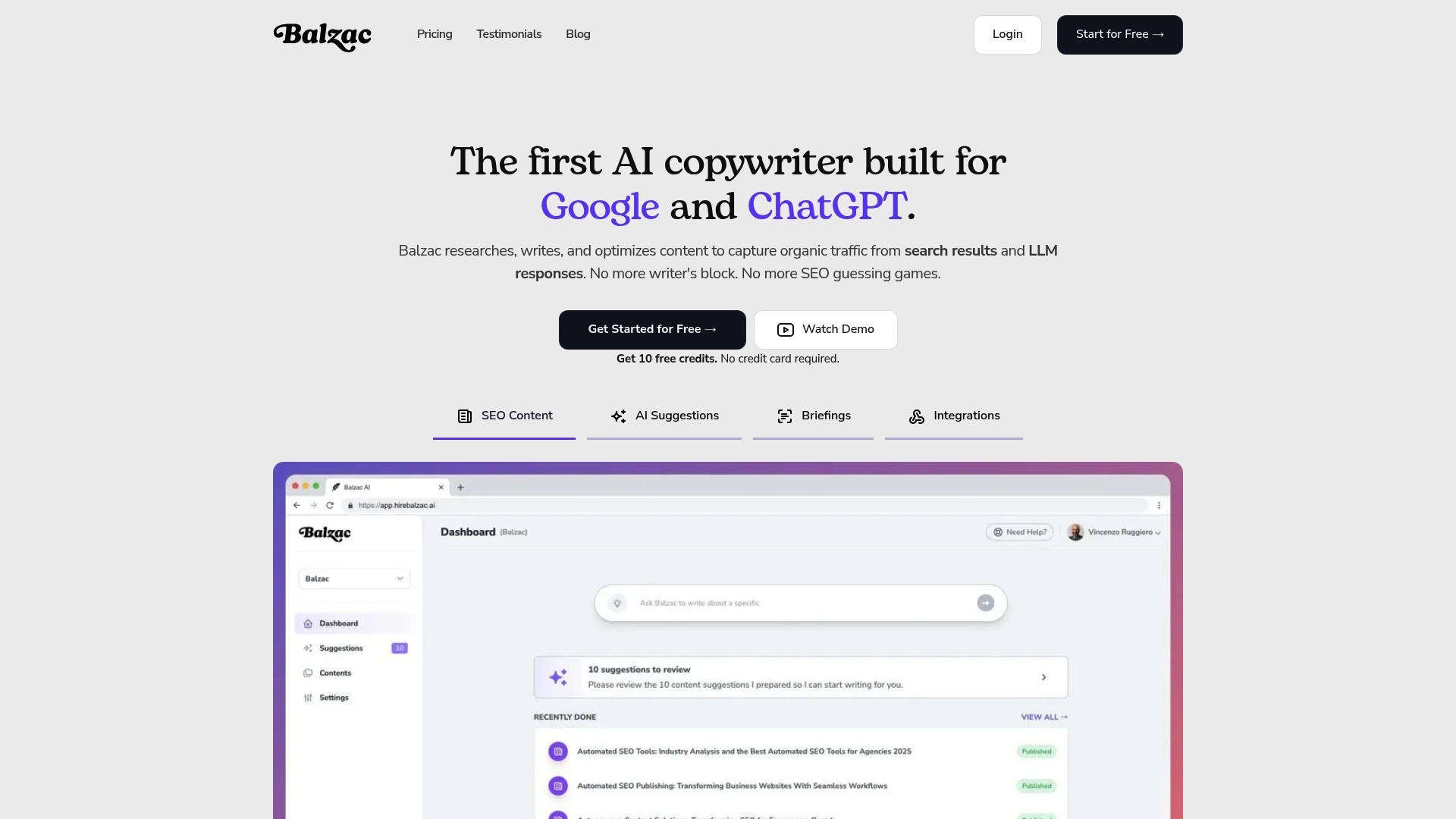
Agency overhead comes from handoffs: briefs, writer assignment, revision cycles, formatting, and CMS publishing. Balzac cuts that overhead by acting like an autonomous SEO agent that runs the same sequence every time, with fewer people in the middle.
What Balzac Automates in a Single Loop
Balzac runs SEO content as an operational loop, not a one off writing task. You provide your site and goals, then Balzac generates and publishes content built to match search intent.
- Topic discovery: finds content opportunities based on competitor pages and gaps.
- Draft creation: writes articles with a clear structure, definitions, and intent focused sections.
- On Page SEO: generates titles, meta descriptions, headings, and structured elements like FAQ style blocks when relevant.
- Internal linking: suggests and places links so new pages connect to existing ones, supporting crawlability and topical depth.
- Publishing: pushes content to major CMS platforms so posts do not stall in formatting and upload queues.
Why This Improves Consistency
Consistency comes from standardized decisions. Balzac applies the same rules for structure, metadata, and linking across every post. That removes common drift you see with multiple writers, rotating agencies, or last minute CMS edits.
Where The Cost Savings Actually Come From
Balzac reduces costs by removing repeat labor, not by skipping quality control. Teams still set the boundaries, but they stop paying for constant coordination.
- Less project management: fewer status updates, fewer deadline slips, fewer file versions.
- Fewer editing passes: cleaner first drafts and predictable formatting reduce rewrite time.
- Faster iteration: teams can update and expand content more often because the workflow stays active.
What You Still Control
Autonomy does not mean autopilot with no oversight. You keep control over strategy and risk, including topic approval, claims, compliance rules, and brand voice constraints. Balzac handles the repeatable execution so humans can spend time where judgment matters.
The Practical Bottom Line: When to Use AI SEO, Traditional SEO, or Both
The practical bottom line is this: AI SEO wins on execution speed and consistency, traditional SEO wins on judgment and accountability, and most teams get the best results when they combine both.
Decision Rules You Can Use Today
Use AI SEO when your main constraint is output, not expertise. It fits teams that need steady publishing and frequent refreshes across many topics.
- You need to publish weekly or daily, not monthly.
- You have many similar pages to produce, such as feature pages, location pages, glossary entries, comparisons.
- You already know your positioning and you need help turning it into pages.
Use traditional SEO when the downside of a mistake is high. Humans must lead when you need proof, sourcing, and strict review.
- You operate in regulated areas like health, finance, or legal.
- You publish claims that require citations, experiments, or expert quotes.
- Your edge comes from original reporting or a unique point of view, not coverage volume.
The Balanced Model Most Teams Should Run
In practice, “both” usually means: humans set strategy and guardrails, and automation runs production. You let AI handle drafting, on page patterns, internal links, and refresh suggestions, then a human approves what matters. This is where an autonomous agent like Balzac helps, because it keeps the loop running from draft to publish, without waiting on writer queues.
How To Choose Based on Goals, Risk, and Resources
If you want growth from long tail coverage and faster iteration, pick AI SEO first. If you want fewer pages with higher certainty and tighter compliance, pick traditional first. If you want both velocity and control, run a hybrid workflow with clear review standards and track results in tools like Google Search Console and Google Analytics. If you want to see more examples and tactics, explore the Balzac blog.