
AI copywriters are advanced digital tools that use artificial intelligence to generate text for a range of marketing and SEO tasks. By analyzing language and user intent, they can create blog posts, landing pages, product descriptions, and more—even at a scale that would challenge large human teams. These systems continue to shape how digital content is produced, giving businesses new ways to reach and engage online audiences swiftly.
How AI Copywriters Create Content
AI copywriters work by processing large datasets of human writing, learning grammar, style, and keyword optimization strategies through machine learning models. When given a prompt, the AI rapidly generates relevant text that matches the required tone, format, and SEO objectives. Some solutions, such as Balzac, fully automate this process, from researching what competitors are doing, to tailoring articles for search engine visibility, and even scheduling instant publishing on major CMS platforms.
The increasing adoption of AI copywriters in digital marketing reflects a pressing need for consistent, SEO-optimized content at a lower cost and with faster turnaround times. As a reliable way to maintain high output, AI content creation removes the bottleneck of manual writing and offers a dependable route to achieving measurable results in organic search and content-driven marketing.
How AI Copywriters Work: Core Technologies Explained
AI copywriters use advanced language models to automate content creation by learning from vast datasets and user input instructions. These systems analyze millions of web pages, articles, and search queries to generate text that matches human style and intent. Natural language processing (NLP) and machine learning are the backbone technologies that drive these functions.
Natural Language Processing: Understanding and Producing Language
Natural language processing allows AI to interpret keywords, context, and search intent. By identifying topic relevance and user goals, NLP systems structure text that reads clearly and answers user questions. Key NLP features in AI copywriters include:
- Topic analysis and keyword recognition
- Grammar and syntax correction
- Intent detection for answering common search queries
Machine Learning: Continuous Improvement and Adaptation
Machine learning algorithms help AI copywriters improve by learning from each piece of feedback and real-world performance. Systems like GPT-4 from OpenAI and Google’s language models adapt their outputs based on these signals. This enables ongoing optimization for relevance, style, and search engine ranking. For example, Balzac integrates real-time competitor analysis to fine-tune content strategy and deliver articles that match or exceed top-ranking competitors.
From Ideation to Publishing: Automation as a Core Feature
By blending NLP and machine learning, AI copywriters can move from topic ideation to SEO optimization and even automated publishing on platforms such as WordPress and Shopify. This end-to-end automation reduces reliance on manual workflows, accelerates delivery, and ensures consistency across channels.
Essential Features of AI Copywriters
SEO Optimization and Content Quality
AI copywriters deliver strong SEO optimization through built-in analysis of keywords, search intent, and on-page factors. They extract trending keywords, adjust for optimal density, and structure articles to improve rankings. This helps businesses publish content that meets search engine requirements on a consistent basis, addressing the core need for visibility and organic growth.
Automated Research and Topic Ideation
Modern AI copywriters produce original content ideas by scanning competitor websites and SERPs (search engine results pages). They aggregate data points, identify gaps, and recommend topics that have high SEO potential. By reducing the time spent on manual research, teams can accelerate their publishing calendars without sacrificing relevance.
End-to-End Automation and Scheduling
Automation features set leading AI copywriters apart. Instead of piecemeal writing tools, new solutions like Balzac oversee the process from ideation and outlining to full article writing and scheduling. Users can configure rules for frequency and type of content, meaning website owners receive a continuous stream of new posts even without daily oversight.
Seamless CMS Integration
Integration with content management systems, such as WordPress or Webflow, eliminates manual uploading and editing. AI copywriters now support direct publishing, formatting, and even image placements based on template styles. This synergy between AI content generation and CMS workflows improves efficiency and multiplies scaling opportunities.
Balzac: Powering Automated SEO Content at Scale
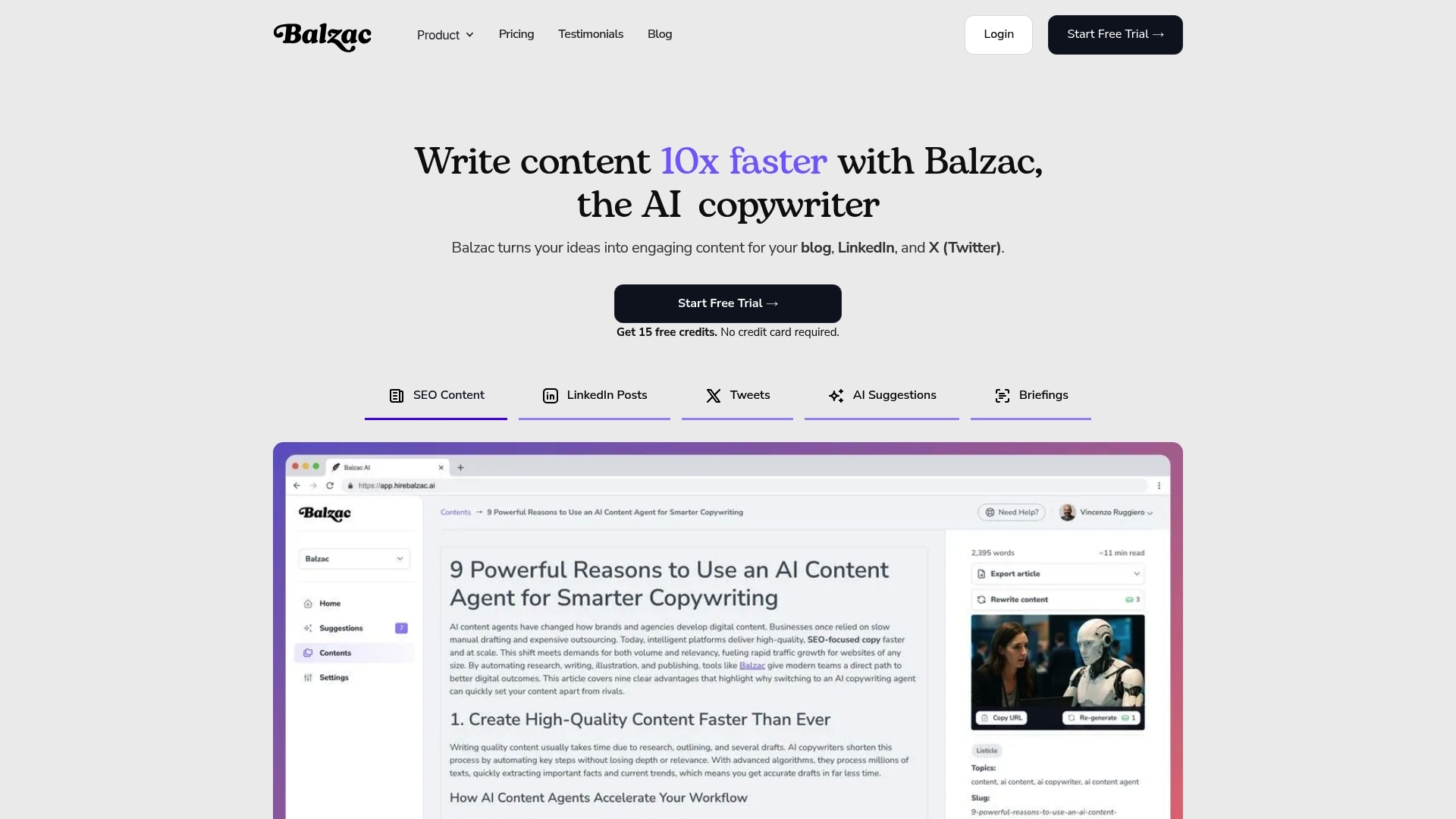
Automating SEO content creation across large websites presents challenges that traditional teams often cannot scale or sustain efficiently. Balzac solves this by providing a fully automated workflow that covers every stage, from competitor research to publishing content directly to platforms like WordPress or Shopify. Users only need to connect their site, and the AI agent handles the rest. This relieves content managers and business owners from constant supervision, reducing manual tasks and minimizing delays.
End-to-End Automation in Practice
Balzac follows a precise sequence to deliver consistent, SEO-optimized content:
- Monitors competitor performance and trending topics in the target niche
- Generates article outlines and drafts tailored for search visibility
- Optimizes for target keywords, headers, and search intent
- Performs grammar checks and readability enhancements automatically
- Publishes completed articles to major content management systems, requiring no human review
Scaling Without Human Teams or Agencies
Unlike legacy workflows, Balzac’s automation is designed for speed and reliability, allowing businesses to scale content output with minimal resources. This is crucial for ecommerce brands, blogs, and digital publishers aiming to increase web traffic and domain authority. By continuously producing and posting relevant content, websites maintain a steady growth in keyword rankings without incurring the recurring costs of writers or external agencies.
The outcome is predictable: sites benefit from 24/7 content production, consistent SEO optimization, and the freedom to focus on strategic initiatives rather than day-to-day writing tasks.
Main Use Cases: From Blogs to Landing Pages
AI copywriters have become essential for managing high-volume content needs across digital channels. They solve persistent challenges for marketers and content teams by quickly producing optimized text for all major formats.
Website and Blog Content Generation
Businesses rely on AI copywriters to draft regular blog articles, news updates, and resource pages. The technology rapidly identifies trending topics by analyzing leading competitors and search behaviors, then delivers structured blog posts at preset intervals. This supports continuous content flow which is crucial for organic search growth. For marketing teams struggling to keep weekly publishing schedules, automation eliminates missed deadlines and manual editorial backlogs.
Landing Pages and Conversion Copy
AI-generated landing pages help capture leads and drive conversions. The content is tailored for audience intent, integrating target search terms, benefit statements, and persuasion best practices. Marketers use platforms like Balzac to auto-create A/B test variants or refresh underperforming pages, improving ROI without needing a creative agency or in-house copywriters.
Ecommerce Product Descriptions
Online retailers need thousands of detailed, unique product descriptions. AI copywriters rapidly produce accurate SKU-level content, updated for SEO and conversion. This reduces duplication penalties, scales up catalog expansion, and frees staff for strategic tasks rather than repetitive writing.
Other Key Use Cases
- Press releases and announcement drafts
- Category and service page text for local SEO
- Automated response templates for customer communications
With tools like Balzac, the challenge of scaling content moves from a bottleneck to an automated process that delivers reliable quality at any volume.
Why AI Copywriters Outperform Traditional Methods
AI copywriters deliver measurable advantages over traditional content creation by human writers, especially in areas where scale, consistency, and resource allocation matter most. The gap is evident in four core areas: speed, reliability, cost, and the ability to handle growing content demands.
Speed and Volume
Automated AI systems generate hundreds of articles in the time it takes a human writer to research and draft a single piece. This rapid production supports campaigns that depend on frequent publishing, such as SEO and e-commerce content calendars. Tools like Balzac can produce and publish optimized articles around the clock, something even the most dedicated human team cannot match.
Consistency and Quality Control
AI copywriters apply preset standards evenly, maintaining tone, grammar, and keyword strategy across every post. This is especially valuable for businesses managing multiple sites or large catalogs. Unlike humans, AI does not tire or introduce variance due to shifting attention, enabling brands to ensure predictable content quality at scale.
Scalability and Adaptability
Scaling content teams often requires significant hiring, training, and management overhead. AI copywriters adapt instantly to changes, from shifting target keywords to evolving SEO rules, and handle content bursts without any operational lag. Adding another website or new topic area is as simple as updating settings within the platform.
Cost-Effectiveness
Over time, using AI copywriters can reduce content production costs by up to 80 percent compared to agencies or in-house teams. Subscription models, such as those offered by Balzac, eliminate unpredictable project fees and allow for transparent budgeting aligned with growth goals.
Automation Benefits: 24/7 Productivity and Consistent Delivery
AI copywriters run without breaks or time limits, giving businesses an immediate advantage for staying visible online. Continuous content production plays a direct role in long-term SEO growth, since search engines favor fresh and regularly updated website material.
Unlocking Always-On Productivity and Scale
Using AI for content creation means productivity is not constrained by office hours or team workloads. New articles, product descriptions, and website updates continue through weekends, holidays, and periods of peak traffic. This 24/7 schedule allows organizations to rapidly respond to trending keywords or competitor moves, filling content gaps as soon as they appear.
Scalability takes a different shape with AI automation. Platforms like Balzac support hundreds or thousands of posts each month, something nearly impossible for manual teams without huge cost and complexity. This high-volume capability is essential for ecommerce, blogs, and digital publishers that require broad topic coverage.
Consistency and Quality for SEO Success
Consistent publishing is a known ranking factor for Google and other major search engines. Automated tools use predefined rules for frequency and structure, ensuring every article meets quality and SEO objectives with minimal errors or omissions. Editing and keyword optimization routines run in the background to keep output stable, regardless of order volume.
- Quality control is embedded, reducing risks of duplicated content or lapses from manual fatigue
- Steady publishing cadence strengthens site authority and signals reliability to users and crawlers alike
This approach lets businesses build SEO momentum, outpace slower competitors, and maintain relevance without relying on unpredictable human workflows.
Best AI Copywriter Tools 2025: Top Solutions Reviewed
In 2025, AI copywriting tools are shaping the content strategies for companies of all sizes. Digital marketers, SEO teams, and business owners trust these platforms to automate high-impact writing tasks and scale their content operations efficiently. For deeper insights into high-impact SEO automation practices, visit the Balzac Blog.
Comparing the Leading AI Copywriters for Businesses
The landscape includes solutions ranging from complete automation to flexible writing assistance. Several market leaders stand out for their advanced technology, ease of use, and reliable SEO performance.
Tool
Core Strengths
Balzac
Fully autonomous SEO content agent, real-time competitor analysis, 24/7 content publishing, seamless CMS integrations for hands-off scaling
Jasper
Flexible writing templates, collaboration features, works well for teams managing diverse content formats
Copy.ai
Rapid generation of marketing copy, idea prompts, and bulk content with simple user controls
Writesonic
AI-powered blogs, landing pages, and product copy, strong API for e-commerce and SaaS use cases
Anyword
Predictive performance scoring, ad and website copy optimized for CTR and conversions
Balzac stands out for businesses demanding true end-to-end automation. It eliminates manual setup by researching, writing, optimizing, and publishing on schedule, letting companies maintain a dominant online presence with fewer resources. Platforms like Jasper and Copy.ai appeal to marketers seeking ideation or team-based workflows, while Writesonic and Anyword offer strong vertical-specific templates. Regular product updates keep pace with evolving SEO guidelines and content publishing needs.
How to Choose the Right AI Copywriter for Your Business
Choosing the right AI copywriter depends on aligning the platform’s capabilities with your business goals and operational requirements. Prioritize clarity in what you need: whether it’s high-velocity blog output, SEO optimization, deep competitor research, or seamless integration with existing systems. Before investing, evaluate a few key areas that set top solutions apart:
Essential Selection Criteria
- Feature Set: Look for AI copywriters that combine automated keyword research, SEO optimization, and real-time competitor tracking. Comprehensive offerings reduce the need for manual intervention and keep output focused on search rankings.
- Ease of Use: The platform should offer a simple onboarding process, intuitive dashboard, and minimal setup. Test usability with trial outputs. Platforms like Balzac require only basic site inputs before handling the entire workflow autonomously.
- Integration Capabilities: Direct publishing to major CMS platforms such as WordPress, Shopify, or Webflow avoids repetitive exports or complicated formatting. Check for plugins or API access to ensure publishing fits your website flow.
- Pricing and Scalability: Subscription models often provide transparent, predictable spending and can scale as site needs increase. Compare annual pricing, content output limits, and whether upgrades are necessary for higher volume. Learn more about available plans on the Balzac Pricing page.
- Data Security and Support: Prioritize platforms with a stated privacy policy, content ownership guarantees, and quick-response support channels.
Review user reviews and recent comparisons of leaders like Jasper, Copy.ai, or Writesonic for benchmarks on reliability and output quality. A solution like Balzac adds extra value for those seeking hands-off automation, integrated SEO, and continuous publishing without daily supervision. Base your decision on long-term operational fit to maximize return on investment.
Trends and Future Outlook for AI Copywriting
AI copywriting is rapidly evolving as technology advances in natural language understanding and automation. In 2026, businesses can expect even closer integration between AI systems and digital marketing platforms. Many platforms now use live data analysis to refine keyword strategy and update articles for the latest search trends, creating a dynamic approach to search engine optimization. AI-generated content is forecasted to produce an even higher share of online articles, product details, and category pages, especially as tools automate everything from research to publishing.
Emerging Capabilities and Industry Developments
Several trends are driving innovation:
- Language models such as GPT-4 and Google’s AI tools continue to improve at understanding style, tone, and search intent, enabling more precise content personalization
- Real-time competitor tracking now shapes topic ideation and content refresh cycles without human oversight
- Full automation pipelines allow instant publishing and on-the-fly optimization for continuously changing algorithms
These advancements reduce the need for manual editing and routine supervision. As a result, AI copywriters handle large-scale demands with minimal intervention, delivering faster turnaround and greater content consistency.
Staying Competitive With AI Strategies
To remain ahead, brands increasingly adopt end-to-end AI agents that provide round-the-clock production and performance monitoring. Platforms like Balzac continually update keyword strategies and adjust content without waiting for manual review. Adoption of such AI-driven workflows ensures timely reactions to search engine changes and competitor moves, keeping digital marketing efforts effective and adaptive in an ever-shifting SEO landscape.
Key Takeaways and Action Steps
Main Insights for Businesses Using AI Copywriters
AI copywriters have changed how digital marketing teams deliver content by providing both immediate productivity gains and long-term growth through automated, consistent SEO publishing. Compared to manual writing, these tools deliver:
- Significant time and resource savings on content production
- Reliable adherence to SEO guidelines with every article
- Automatic integration with major CMS platforms like WordPress and Shopify
- Continuous publishing to maximize search engine visibility
Solutions such as Balzac, Jasper, and Copy.ai empower businesses to move from sporadic updates or overwhelming content backlogs to predictable, high-quality publishing schedules that adapt quickly to changes in strategy and competition.
Action Steps to Implement AI Copywriters Effectively
A few clear steps can help organizations maximize value when adopting AI copywriters:
- Identify your content needs and publishing frequency (e.g., weekly blog posts, daily product updates, landing page revisions).
- Map these requirements to available tool features, giving priority to platforms that offer integrated SEO checks and publishing automation.
- Test outputs with a small set of topics or product pages to verify style and SEO accuracy. Many platforms offer free trials or trial content.
- Connect the chosen AI tool with your website’s CMS for direct publishing, reducing manual transfers and editing steps.
- Schedule regular audits of content quality and SEO impact, using analytics tools like Google Search Console or SEMrush to monitor performance improvements.
- Iterate rules or prompts to refine article quality over time or expand to new content types based on business growth.
In practice, Balzac requires only a website connection and a set of preferences for target topics or keywords to deliver fully automated, SEO-optimized posts directly to your site. This allows lean teams or even single operators to focus on overall strategy instead of daily writing and coordination.
Sustaining Success with Automated Content Workflows
Monitor content performance by tracking changes in keyword rankings, organic sessions, and conversion rates. Update your targets and publishing rules as algorithms or business needs evolve. The leading platforms regularly release new features aligned with SEO best practices and new search technologies, so staying up to date ensures your content benefits from the latest capabilities.
Prioritize flexibility and reliability in your AI copywriting choice so your business can adjust easily to scale, expand across topics, and outpace manual competitors.