
AI content software uses artificial intelligence to generate, optimize, and automate written content for websites, blogs, and digital campaigns. These platforms analyze keyword data, competitor content, and topic trends to create SEO-focused articles with minimal human effort. As businesses face greater pressure to publish more content quickly and maintain search engine rankings, tools powered by AI have moved from novelty to necessity in digital marketing strategies.
How AI Content Software Works in Digital Marketing
Modern AI content tools blend machine learning, natural language processing, and data-driven SEO strategies. The workflow usually looks like this:
- Analyze popular keywords relevant to your niche or business goals
- Synthesize information from top-ranking pages using competitor analysis
- Generate original articles, product descriptions, or landing page copy tailored to SEO requirements
- Automate publishing directly to major content management systems (CMS)
This automated process helps marketers and site owners improve consistency and free up time, allowing them to focus on other aspects of their campaign. Software like Balzac enables users to set content strategies and rely on AI to deliver and publish fully optimized articles without manual input, solving key pain points for both individuals and teams. As search engines demand higher-quality and better optimized content, these tools are having a growing influence on who reaches the top of results pages.
How Ai Content Software Automates SEO Content Creation
AI content software streamlines the entire SEO content process by using machine learning and natural language processing. These tools analyze keywords, review competitor content, and draft optimization-ready articles or blog posts, all within minutes. The process starts with automated research: users enter a broad topic or keyword, and the AI reviews popular search queries, intent, and ranking competitor pages. This ensures each piece of content targets topics your audience is genuinely searching for while adhering to current search engine optimization benchmarks.
From Research to Optimization: Key Stages
The automation workflow typically follows a consistent pattern:
- Keyword Research: The system identifies high-impact keywords and related search phrases using data-driven analysis.
- Competitor Analysis: It reviews top-ranking pages to benchmark tone, word count, and headings.
- Content Generation: AI models generate original drafts that incorporate target keywords and follow SEO best practices for structure, headers, and meta descriptions.
- On-Page Optimization: Some tools audit readability, internal linking, image alt text, and overall compliance with on-page SEO rules.
- Automated Publishing: Many platforms offer one-click or scheduled publishing to content management systems including WordPress, Shopify, and others.
Example: Fully Autonomous Content Agents
Balzac, for example, offers end-to-end SEO automation without daily human oversight. Users specify their site or blog, and the AI agent manages everything from idea discovery and drafting to SEO enhancement and direct publishing. Continuous competitor tracking and automated adjustments help keep content performance optimal, reducing the time and labor needed for effective SEO.
Key Features of Leading Ai Content Software
AI content software brings a set of unified features designed to streamline every stage of SEO content creation. These capabilities address major user needs: generating effective, search-friendly text and ensuring content reaches audiences fast.
Keyword Integration and Topic Research
Modern platforms like Jasper, Copy.ai, and Balzac use AI to identify high-value keywords tailored to a user’s niche. They scan search engine data for ranking opportunities, integrating these terms naturally into articles. The result is content with keyword density that matches top-ranking competitors, without sounding forced.
Competitor Analysis
Many leading solutions now include built-in competitor analysis modules. These tools automatically research:
- Top-ranking content topics
- Length and structure of successful articles
- Commonly used on-page SEO elements (such as headings, meta descriptions, and links)
This information helps users match or exceed competitor content in both depth and optimization.
Content Customization and Language Adaptation
AI engines allow users to set tone, brand voice, and content style guidelines upfront. Some, including Balzac, support multilingual content for reaching global markets. Editable templates and draft revisions help users maintain unique voices and industry compliance.
Automated Publishing to CMS Platforms
A distinguishing feature of advanced software such as Balzac is automated delivery of finished content directly to popular platforms like WordPress, Shopify, or Webflow. This automation cuts manual uploads, ensuring articles go live on a set schedule and maintaining a steady publishing pace.
What Sets Them Apart
The strongest platforms combine all these features into one continuous workflow, saving hours each week. Autonomous operation and tight content-SEO integration allow teams of any size to scale up their publishing while keeping quality consistent.
Balzac: The Autonomous SEO Agent for Complete Content Automation
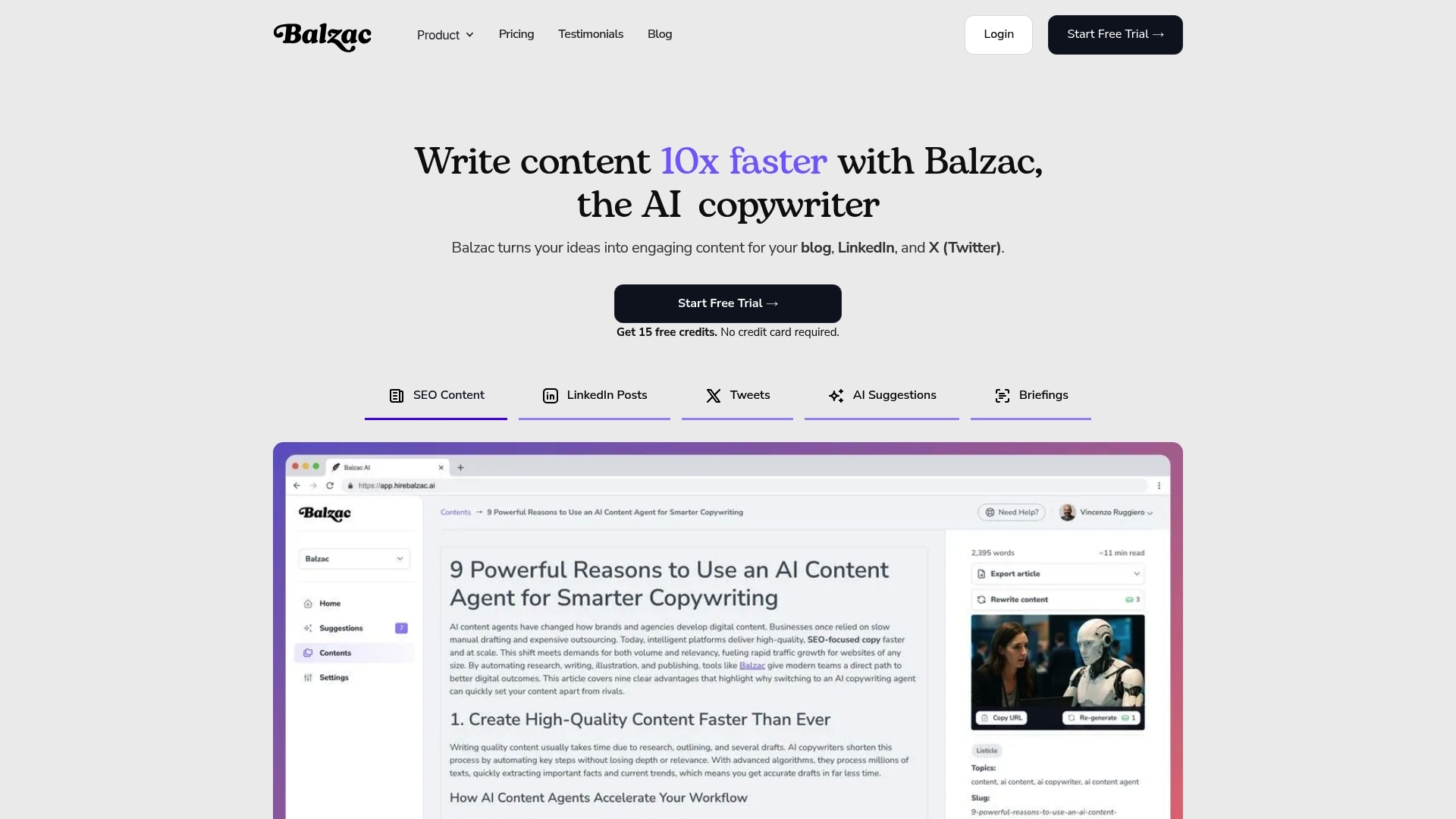
Balzac operates as a fully autonomous SEO agent designed to simplify every aspect of content production for digital growth. Instead of manual topic research, writing, editing, and publishing, users delegate these tasks to Balzac for continuous content output. After users provide site details and content goals, Balzac independently discovers ranking opportunities, drafts SEO-focused articles, and publishes them to leading content management systems.
End-to-End Workflow for Hands-Off Publishing
The core value of Balzac lies in its ability to function without routine human oversight. The system performs:
- Automated Keyword Discovery: Identifies high-impact, trending search terms relevant to the user’s niche using live search data and competitor monitoring.
- Topic Selection and Planning: Proposes content ideas based on competitive gaps and target audience intent.
- Content Generation: Creates SEO-optimized drafts integrated with strategic keywords, clear structure, and best practices for on-page optimization.
- One-Click or Scheduled Publishing: Directly uploads finished articles to platforms like WordPress or Shopify, reducing delays and manual work.
Features That Set Balzac Apart
- Operates around the clock, ensuring sites receive fresh, optimized content regularly
- Makes real-time adjustments based on competitor movements and emerging search trends
- No need for hands-on SEO guidance or external content agencies
- Consistent quality and adherence to SEO best practices for sites of any scale
Using an autonomous approach, Balzac helps teams and individuals keep pace with algorithm updates and evolving search intent. The result is a steady flow of targeted content that can improve visibility, audience engagement, and organic rankings with minimal daily management. For further examples and insights, visit the Balzac Blog • Fully autonomous AI SEO agent.
Why Choose Ai Content Software Over Traditional Content Creation?
AI content software reshapes how businesses and individuals approach the challenges of producing optimized, high-volume content. Traditional content creation, which often depends on hiring freelance writers or agencies, requires significant time and ongoing costs. In contrast, AI-driven solutions offer an always-available resource that delivers articles and web pages on demand, no matter the publication schedule.
Key Advantages at a Glance
- Time Savings: AI platforms generate articles in minutes. There is no back-and-forth with writers or waiting for drafts and revisions, making it possible to meet tight publishing schedules efficiently.
- Lower Costs: Once set up, AI solutions eliminate freelance or agency fees. This reduces the content budget, especially for companies scaling up or maintaining several sites.
- Scalable Content Output: These tools make it possible to produce many articles at once, maintaining a regular flow even for large sites or businesses running multiple content campaigns.
- Consistency and Standardization: AI enforces style guidelines, keyword density, and structural rules across all content. This level of control is difficult to sustain with a rotating pool of human writers.
Platforms like Balzac take this further by running autonomously and integrating direct publishing. Users provide their website details, and the system manages everything from targeting the right search terms to scheduling posts. This streamlines workflows and minimizes human bottlenecks, which means content teams can focus resources elsewhere.
For organizations aiming to keep pace in competitive search rankings, the shift to AI content software allows for more responsive, cost-effective, and reliable content marketing efforts. As feature sets keep evolving, these tools keep closing the gap on creativity and subject expertise—two former strengths of traditional writing teams.
Typical Use Cases: Businesses and Individuals Benefiting From Automation
Blog Management for High-Volume Publishing
Blog owners and content marketers use AI content software to meet growing demands for SEO-optimized posts on a consistent schedule. These tools can automate topic research, generate draft articles, and publish directly to content management systems. For example, a news outlet managing several blogs can keep each updated with timely, relevant posts using tools like Jasper or Copy.ai. The regular, automated output helps sites gain more organic traffic and improves search rankings without extra hiring or manual coordination.
Ecommerce Product and Category Descriptions
Online retailers with large product catalogs face challenges in creating unique, search-optimized descriptions for thousands of items. AI-driven platforms accelerate this process. They generate individualized product and category copy with relevant keywords, formatting, and even multilingual support. Shopify merchants, for instance, streamline their workflow by employing automated content agents that write and update listings at scale, which is key for broad inventory management.
Automated Local SEO for Service Providers
Businesses focused on local audiences, such as law firms or plumbers, turn to AI content software to quickly develop geo-targeted landing pages and service area information. These pages typically include region-specific keywords and addresses, tailored to rankings in local search results. By using automated content generation, local SEO consultants and small businesses can rapidly launch or update dozens of local site pages keeping information accurate and competitive.
Ongoing Marketing Campaigns for Agencies and Startups
Marketing agencies, SaaS startups, and personal brands benefit from bulk automation in campaign content production. AI content tools help generate landing pages, newsletters, and press release drafts, making it easier to experiment with messages and test ideas for engagement. Automation supports tight marketing cycles, helping teams adapt to keyword trends and seasonal topics with minimal prep work.
Solutions like Balzac further automate every step, delivering end-to-end SEO content for blogs, commercial sites, or regional campaigns, all while saving staffing costs and reducing manual errors.
Challenges and Limitations of Ai-Generated SEO Content
Many users face issues with AI-generated SEO content because the technology is not flawless. While automation offers speed and scale, certain challenges can impact results and brand integrity if not addressed.
Content Quality and Factual Accuracy
AI models may produce text that sounds convincing but occasionally lacks depth or factual precision. Because these systems rely on patterns in training data, they can misinterpret ambiguous prompts or insert inaccuracies, especially in technical industries. Regular human review is crucial to spot errors, check for proper context, and update outdated information. Misinformation can harm credibility and rankings, so always combine automation with oversight.
Limited Creativity and Originality
Generative AI content typically focuses on information already covered online. This can lead to repetitive phrasing and limited unique insights. Original ideas, fresh analysis, or clever storytelling are still stronger when crafted by humans. Use AI for drafts or summaries, then refine with personal expertise or fresh data. Blending automation and human editing helps create content that stands out rather than blending into search results.
Risk of Over-Reliance and Content Uniformity
If organizations depend solely on automated workflows, sites may start to look and read the same. Over-automation reduces brand distinctiveness and suppresses innovation. Integrate AI with a varied content strategy that includes custom visuals, expert input, and manual adjustments. For example, Balzac users often supplement autonomously generated articles with brand stories or specialized guides to keep engagement high.
SEO Compliance Issues
Algorithm updates from search engines like Google can change what qualifies as quality, SEO-friendly content. AI-generated articles may lag behind these shifts unless software providers continuously update their algorithms. To minimize risk, monitor results and choose AI tools that remain responsive to SEO guideline changes.
What to Expect in Ai Content Software Reviews 2025
When comparing or researching AI content software in 2025, focus on practical benchmarks that show which platforms deliver the strongest mix of efficiency, accuracy, and business value. User expectations and technology standards change quickly, so criteria for evaluation must address both the pace of AI evolution and the needs of modern SEO strategies.
Core Review Criteria for 2025
- Content Accuracy and Reliability: Evaluate how well the tool generates fact-checked, up-to-date information and avoids superficial or outdated results. Leading solutions increasingly reference real sources or use live search data to anchor their output.
- Speed and Throughput: Assess how fast the software processes input topics or keywords and publishes usable drafts. For organizations that need high output, faster content cycles translate directly to more opportunities.
- Usability and User Experience: Consider dashboard clarity, ease of workflow setup, and how quickly a new user can become productive. Simple, logical interfaces reduce training time and minimize errors.
- Integrations and Ecosystem Compatibility: Look for seamless publishing connections to major CMS platforms like WordPress, Shopify, or Webflow, as well as compatible APIs for connecting with project management or analytics tools.
- Value and Total Cost: Analyze pricing structure in relation to ROI. This includes feature breadth, ongoing results, and reduced reliance on external writers or agencies. Autonomous agents, such as Balzac, add value by automating end-to-end production and optimizing publishing with minimal oversight. For a detailed breakdown, see the Pricing • Balzac AI • Fully autonomous AI SEO copywriter agent page.
Reviewers increasingly highlight security, update frequency, multilingual support, and compliance with AI content guidelines from Google. Software that adapts quickly to changing search engine requirements will stand out in annual analysis. As the ecosystem matures, platforms offering reliable autonomy, smart integrations, and strong accuracy controls set the pace for what users expect in the next wave of AI-driven content creation tools.
Conclusion: Choosing the Best Ai Content Software for Your Needs
Selecting the right AI content software involves understanding your specific content goals, the size of your team, and how automation will fit into your workflow. The ideal tool should help you solve for scale, efficiency, and SEO gains without sacrificing quality or brand standards.
Steps to Assess the Best-Fit Solution
- Define Your Core Objectives: Specify whether you need ongoing blog posts, ecommerce content, or extensive local SEO. This clarifies which software features matter most for your site.
- Estimate Required Output Volume: Measure how many articles, product pages, or landing pages you need each week or month to stay competitive.
- Review Team Size and Available Resources: Solo site owners and lean teams can benefit heavily from hands-off automation, while larger organizations may value collaborative platforms with editing controls.
- Analyze Current Workflow: Consider which steps eat up the most time—topic research, drafting, editing, or publishing. Look for tools that automate your biggest bottleneck.
- Test for SEO Performance: Ensure the software can target up-to-date keywords, follow SEO best practices, and adapt to algorithm changes. Evaluate output by checking search visibility improvements over time.
- Check CMS Integration: For web admins using major platforms like WordPress or Shopify, integration is key to real efficiency. Look for seamless publishing features for true automation.
What to Prioritize When Comparing Tools
Criteria
Why It Matters
Content Accuracy and Quality
Minimizes need for manual revision and helps retain authority, especially in technical or regulated sectors
Speed of Generation and Publishing
Faster content turnarounds let you react to trends and maintain high output
Customizability and Flexibility
Supports different brand voices, content formats, and language needs for global teams
Integration Capabilities
Direct publishing to your preferred CMS or marketing stack enables a true end-to-end automated workflow
Ongoing AI Updates
Keeps content aligned with changing search engine algorithms and evolving SEO standards
Modern solutions like Balzac cover all core steps, starting from autonomous research and content generation to competitor tracking and direct publishing, making them especially valuable for users needing intelligent, full-cycle automation. Teams seeking to reduce manual monitoring and focus on growth can use these platforms to steadily increase output and adapt quickly to changing SEO requirements.
For organizations wanting to leverage automated SEO, reviewing several leading software options with your requirements in mind is crucial. Use trial versions where possible to evaluate workflow fit and result quality. Ask whether the level of automation suits your preferred amount of oversight. Identify which tool brings the greatest return as content needs evolve. With the right AI content software, your strategy can keep pace with digital trends and consistently attract targeted search traffic.