
AI content automation means you use software to research, write, optimize, and publish SEO content with minimal human effort. For SEO driven businesses, it turns a long, manual workflow into a repeatable system that keeps your site fresh, expands keyword coverage, and reduces bottlenecks.
This checklist shows the exact process you can follow to move from “we need more content” to published pages that target search intent, without relying on constant writer availability. Tools such as Balzac can run many of these tasks continuously by generating drafts, applying on page SEO, and publishing to major CMS platforms, while you keep control through review rules and priorities.
What You Will Implement in This Checklist
- Choose target pages and keywords based on business value and search demand
- Create a clear brief that defines intent, structure, and facts to include
- Generate a draft, then improve uniqueness, accuracy, and voice
- Apply on page SEO (titles, headings, internal links, metadata)
- Publish, measure performance, and update content on a schedule
What Is AI Content Automation (and How Does It Work)?
You just saw the high level checklist. This section explains the engine behind it: AI content automation turns a keyword or brief into a publish ready page with far less manual work.
AI Content Automation Defined
AI content automation is a workflow where software handles research, drafting, on page SEO, and publishing, while a human sets goals and approves outputs. It combines large language models with SEO data sources and CMS integrations to produce consistent content at scale.
How AI Turns Keywords Into Drafts
The process starts with inputs you already use: a target keyword, a page type (blog post, landing page, FAQ), a reader profile, and any brand rules. The AI then builds a draft by matching search intent and outlining a structure that answers the query clearly.
Most systems pull supporting context from sources such as Google Search results, your existing site content, and SEO tools like Ahrefs or Semrush. That context helps the draft include the right subtopics and terminology, not just filler text.
How On Page SEO Gets Optimized Automatically
On page optimization means the AI aligns the page with what search engines and readers expect. In practice, automation usually handles:
- Title tag and meta description suggestions based on the primary keyword.
- Heading structure (H2s and H3s) that matches common questions and sub intents.
- Internal link opportunities by finding relevant pages on your site to reference.
- Schema markup recommendations for eligible content types, such as FAQ schema when relevant.
How Publishing Works With Minimal Human Input
After the draft, the system formats content for your CMS, adds images or alt text when configured, and pushes it to platforms such as WordPress. A human usually stays in the loop for a quick review, fact checks, and final approval.
Tools like Balzac aim to connect the full chain, from research to writing to CMS publishing, so you spend time on decisions, not repetitive production work.
Why SEO-Driven Businesses Use AI Content Automation
Manual SEO content breaks down in the same places for most teams: people, process, and time. You can plan a content calendar in a day, then lose weeks to briefs, writer backlogs, edits, and publishing delays. AI content automation exists because SEO rewards consistent execution more than occasional bursts.
Manual Content Production Pain Points
Cost adds up fast. A typical workflow needs research, writing, editing, and SEO review, and each handoff creates extra hours and extra invoices. Even with in house writers, you still pay in opportunity cost when specialists stop doing core work to fix content.
Speed also limits growth. A team that publishes 2 posts per month can only test 24 topics per year. That pace makes it hard to learn what works, respond to new search demand, or refresh pages that slip in rankings.
Inconsistency hurts results. Writers change, templates drift, and quality varies. That inconsistency shows up as mismatched tone, weak structure, missing internal links, and uneven keyword targeting.
SEO Outcomes Automation Improves
AI automation improves SEO because it makes output predictable, and SEO systems reward sites that cover topics deeply and keep pages current.
- Keyword and topic coverage: You can publish more supporting articles and long tail pages that match real search intent.
- Freshness: You can update existing pages more often, which matters in fast changing spaces where content goes stale.
- Internal linking: Automation can suggest and insert relevant links between related pages, which helps crawlers find content and helps users move through your site.
- On page consistency: Titles, headings, meta descriptions, and structured sections stay aligned to a standard.
Why Businesses Choose Always On Automation
Businesses choose automation when they want scale without hiring. An autonomous agent such as Balzac can run research, draft creation, on page optimization, and publishing on a schedule, while your team focuses on approvals, facts, and positioning.
AI Content Automation Checklist: 12 Must-Do Steps
You now know how automation turns a keyword into a CMS ready draft. Use the checklist below to make that process repeatable and safe for SEO.
AI Content Automation Checklist: 12 Must Do Steps
-
Pick the page type and goal: blog post for top of funnel traffic, landing page for conversion, or help article for support deflection.
-
Select one primary keyword per page, then list 3 to 8 supporting queries that match the same intent.
-
Validate intent in Google: scan the top results for format (list, guide, comparison), angle, and common subtopics. Use Google Search Essentials as your baseline for what quality looks like.
-
Run competitor content analysis: capture headings, questions, and missing points. Tools like Ahrefs or Semrush can speed this up.
-
Write a tight brief: audience, promise, key facts to include, what to avoid, required products or entities, and sources you trust.
-
Generate the first draft: keep the prompt specific (tone, structure, word count range, and internal pages to reference). Balzac can automate this draft step on a schedule.
-
Check facts and claims: confirm numbers, dates, and definitions, remove anything you cannot verify, add citations where relevant.
-
Run a uniqueness check: avoid copying competitor phrasing, rewrite repeated patterns, and add first party details. Use a plagiarism tool if your process requires it.
-
Apply on page SEO: title tag, meta description, clean H2 and H3 structure, short paragraphs, descriptive alt text, and schema only when accurate.
-
Add internal links with intent: link to a next step page, a supporting definition, and one high value conversion page. Use descriptive anchor text.
-
Publish with QA: check formatting in your CMS, slug, canonical, indexability, and mobile layout. Keep a simple approval rule for final human review.
-
Measure and iterate: track impressions, clicks, and queries in Google Search Console, then update content based on what ranks, what slips, and what users still ask.
How to Use AI for Creating Unique Blog Content (Without Sounding Generic)
Unique AI blog content comes from your inputs and your edits, not from a different prompt. Treat AI as a fast drafter, then add proof, opinions, and specificity that only your business can provide.
Use First Party Data as the Core Ingredient
The fastest way to avoid generic content is to include numbers your competitors do not have. Add one small dataset to each post, then make the AI explain what it means.
- Sales and CRM: win rates, deal cycle length, top objections
- Product: feature adoption, time to value, support ticket themes
- Marketing: conversion rates by channel, top landing pages, email CTR
Example prompt add on: Use these 6 support ticket themes, explain the root cause, and propose fixes.
Force a Unique Angle Before You Draft
Generic posts try to cover everything. Better posts pick one clear point of view, then support it.
- Choose one enemy: “Why checklists beat long playbooks for busy teams”
- Choose one audience: “For B2B SaaS with 2 person marketing teams”
- Choose one constraint: budget, time, compliance, or risk
Add Real World Examples and Named Entities
Ask the AI to include specific tools and workflows your readers recognize. Named entities reduce vagueness and help search engines understand context.
- SEO tools: Ahrefs, Semrush, Google Search Console
- CMS platforms: WordPress, Webflow
- Analytics: Google Analytics
Collect Expert Quotes Without Slowing Down
Quotes make posts sound human, but you need a process. Use a shared doc and capture short, verifiable statements from your team.
- Ask 1 question: “What do customers misunderstand about this topic?”
- Store answers with name, role, and date
- Insert 1 quote per 800 to 1200 words
Apply Editing Rules That Remove AI Tells
Run every draft through a consistent pass. Tools like Balzac help you scale drafts, but your rules protect voice and accuracy.
- Delete filler sentences and repeated points.
- Replace vague claims with numbers, sources, or examples.
- Check every fact, especially pricing, limits, and legal claims.
- Rewrite the first paragraph in your brand voice.
- Add internal links and product mentions only where they answer the query.
Balzac: An Autonomous SEO Agent for Always-On Publishing
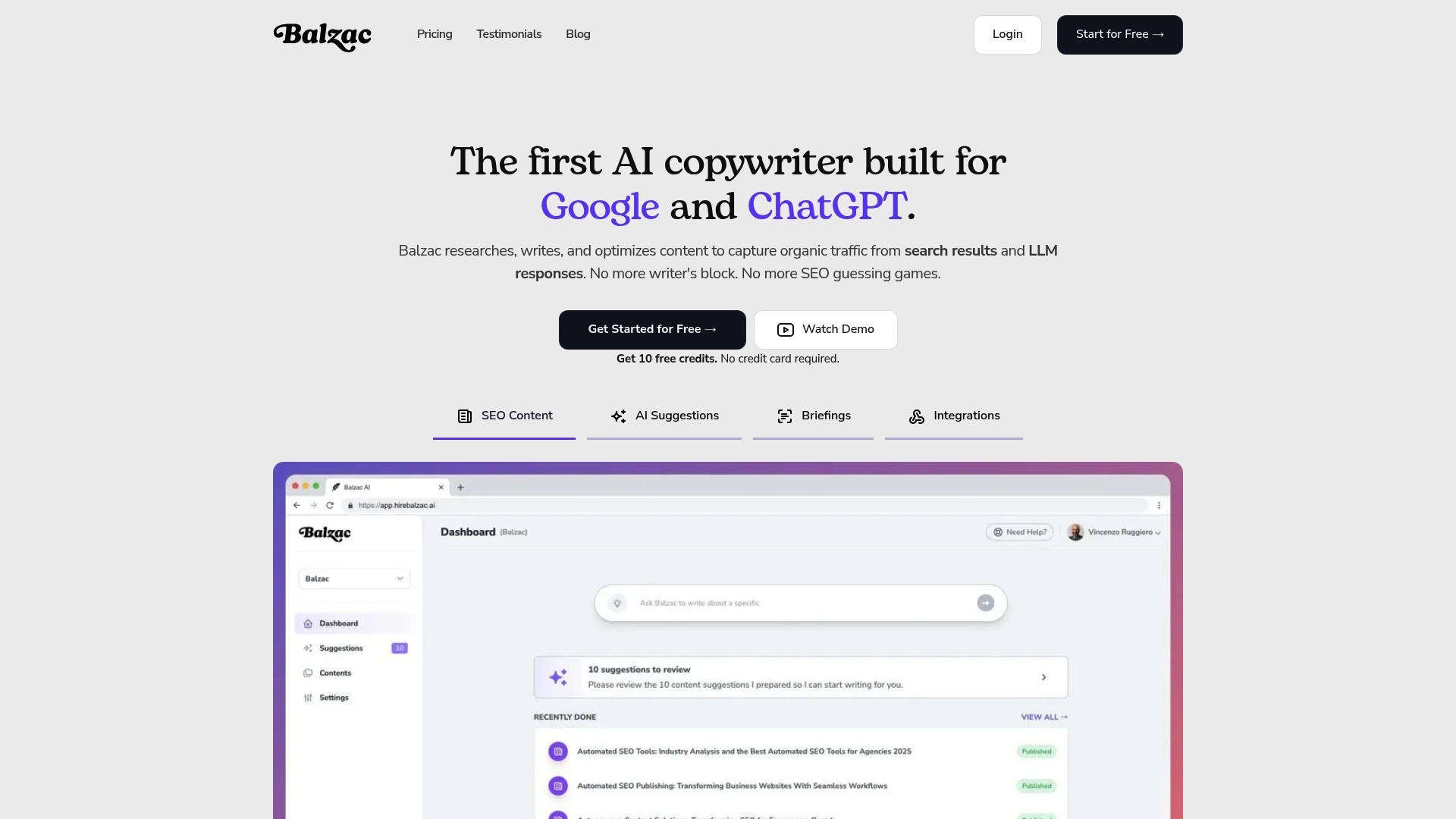
If you want the checklist to run on a schedule, you need a system that covers the full chain: research, writing, on page SEO, and publishing. Balzac positions itself as an autonomous SEO agent that can produce and ship content continuously, while you keep control through inputs, approvals, and guardrails.
How Balzac Handles Research, Writing, Optimization, and Publishing
Balzac starts with your site context and targets, then it builds content that matches search intent. In practical terms, it aims to replace the repeated manual steps teams do for every article.
- Research: It can scan competitors to find common headings, gaps, and topic angles, so you do not start from a blank page.
- Drafting: It generates an article that follows a structured outline and includes the entities and subtopics that usually appear in top ranking pages.
- On Page SEO: It prepares titles, headings, and metadata, and it can suggest internal links based on your existing pages.
- Publishing: It can publish to major CMS platforms, which reduces the handoffs that often delay output.
What To Check Before You Trust Always On Publishing
Always on content only helps if it stays accurate and consistent. Use the checks below to compare Balzac, or any similar tool, against your manual workflow.
- Inputs and control: Can you set page types, topics, excluded claims, and brand rules clearly, then enforce them every time?
- Fact safety: Does the workflow force a human to review factual claims and remove anything you cannot verify?
- Uniqueness: Can you inject first party details, examples, and a distinct angle, instead of repeating the same patterns as competitors?
- SEO hygiene: Does it handle titles, headings, internal links, and indexability checks in a repeatable way?
- Measurement loop: Can you track performance in Google Search Console and use those queries to update future content?
Evaluate Balzac like a process upgrade: if it removes repetitive work while keeping human review on critical accuracy and positioning, it usually beats ad hoc writing and publishing cycles.
FAQ: AI Content Automation for SEO
You can use the checklist above, then keep results stable by answering the same set of questions every time you scale. This FAQ focuses on the risks that actually affect SEO output, quality, originality, policy compliance, review, and measurement.
Does AI Content Rank on Google?
Yes, AI content can rank if you publish pages that help users and match search intent. Google focuses on content quality, not the method used to produce it. Use Googles guidance on helpful content to keep your standards clear.
How Do You Keep AI Content High Quality?
Quality comes from inputs and controls. Set a brief that defines intent, structure, and facts, then force accuracy checks before publishing.
- Require sources for stats, medical claims, legal claims, or pricing.
- Use examples from your product, customers, or workflows.
- Rewrite openings so the first paragraph sounds like your brand.
Will AI Content Trigger Plagiarism Issues?
It can if you let the model echo competitor phrasing. Reduce the risk by adding first party details, running a plagiarism scan when needed, and checking the draft against the top ranking pages for repeated sentences.
Do You Still Need Human Review?
Yes, a human should approve anything that affects revenue or compliance. Keep review tight and specific:
- Fact check every number, limitation, and promise.
- Remove vague claims that you cannot prove.
- Confirm internal links point to the right next step.
How Long Until You See SEO Results?
Timing depends on site authority, competition, and crawl frequency. Many teams see early signals first, such as impressions and new queries in Google Search Console, before they see sustained clicks and top rankings.
How Do You Measure Success?
Track outcomes, not word count. Use Google Search Console for impressions, clicks, and query growth, then add conversion tracking in your analytics. If you use an agent like Balzac, measure consistency too, drafts produced, pages published, updates shipped, then tie those to search growth and leads.