
Your “Frase alternative” decision usually comes down to one question: who clicks publish? With Frase (often searched as frase io seo), your team still runs the workflow—research, brief, draft, optimize, then copy into your CMS. Balzac flips that model. You connect your site, set rules, and the agent researches, writes, formats, and publishes pages without a writer in the loop.
That difference changes everything: how many steps live in Slack, how much editor time you burn per page, and how reliably you can hit a weekly publishing target. The comparison below is built for that reality. Scan it to see whether you need an editor assistant that tightens human output, or a zero-touch agent that ships content end-to-end.
| Category | Frase | Balzac |
|---|---|---|
| Automation Level | Assistant for research, briefs, and optimization | Autonomous agent for research, writing, and publishing |
| Typical Workflow Steps | Pick keyword, generate brief, write in editor, optimize to score, export, publish | Connect site, set topics and guardrails, agent generates and publishes |
| SEO Features | SERP-based outlines, topic/term suggestions, content scoring, competitor insights | Keyword and competitor research, SEO-structured drafts, internal linking suggestions (when configured), publish-ready formatting |
| Publishing | No native end-to-end publishing, you usually copy into a CMS | Publishes to major CMS platforms (per product setup) |
| Integrations | Commonly used with Google Docs, WordPress, and other editorial tools via exports and workflows | Designed around CMS connections and automated posting workflows |
| Best-Fit Use Cases | Teams with writers who want faster briefs and tighter on-page optimization | Teams that want consistent publishing volume with minimal human time |
| Who Owns Quality Control? | Editor and writer review every draft | Guardrails, templates, and optional approvals (depending on workflow) |
What Are You Actually Buying: Editor Assistant or Zero-Touch Agent?
Those workflow steps in the table are the real product. When people search for a frase alternative, they often think they are shopping for “better AI writing.” In practice, they are choosing between two operating models: an editor assistant that helps humans produce pages, or a zero-touch agent that produces and publishes pages for you.
Frase is an assistive SEO content tool. You use Frase (often referred to as “frase io seo” in searches) to research a topic, build a content brief, and score a draft against terms and headings seen in top-ranking pages. A human still owns the work: deciding the angle, writing the draft, editing for accuracy and voice, and pushing it into WordPress, Webflow, or another CMS.
Balzac is an autonomous research-write-publish agent. You set the site, the guardrails, and the publishing rules. Balzac handles keyword and competitor research, drafts the page, formats it for the target CMS, and publishes on a schedule. The “product” is time saved and throughput: fewer handoffs, fewer steps, fewer places content gets stuck waiting for a writer or editor.
Frase Vs Balzac: Who Each Model Fits
Pick Frase if your bottleneck is direction, not production. Frase works best when you already have writers (in-house, freelance, or agency) and you want tighter briefs, faster SERP research, and a consistent optimization checklist. Editorial teams that care about line-level craft, heavy fact-checking, or regulated claims usually prefer this assistive model because it keeps humans in the loop by default.
Pick Balzac if your bottleneck is execution. Balzac fits lean teams that need a steady cadence of SEO pages without hiring writers, managing freelancers, or running a long review queue. It also fits founders and operators who want content to move from idea to published URL with minimal attention, then measure results in Google Search Console and iterate.
The quickest way to decide in the Frase vs Balzac debate is to ask one question: do you want software that helps your team write, or software that replaces the writing and publishing workflow?
1. Balzac
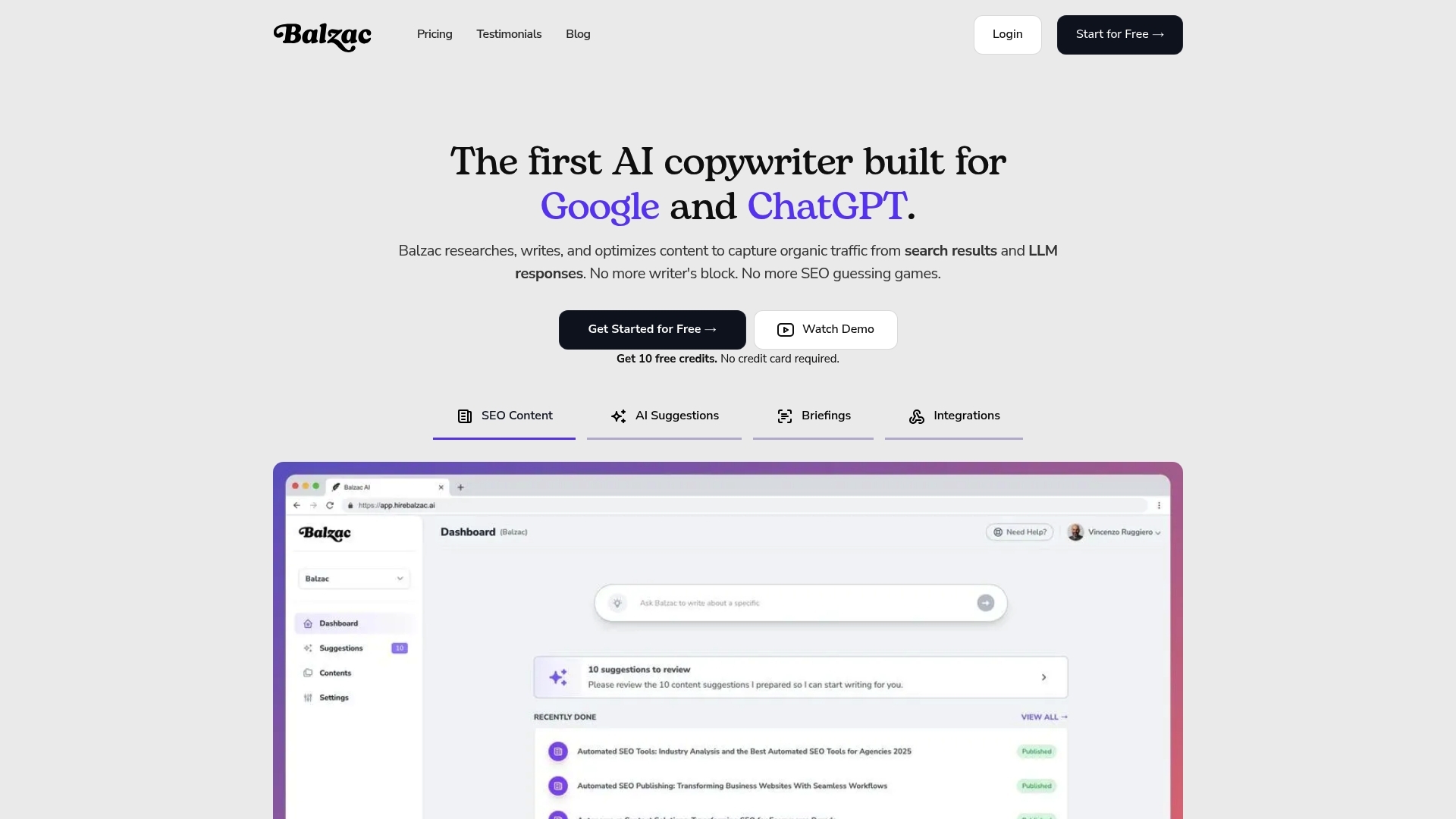
If your idea of a Frase alternative is “replace the writing workflow,” Balzac is the clearest example in this list. In a Frase vs Balzac evaluation, Balzac behaves less like an editor assistant and more like an autonomous SEO agent: it researches topics, drafts pages, formats them for the web, and publishes to your CMS once you connect it and set rules.
Balzac is built for teams that want consistent output without staffing a writing bench. You give it your site, your categories, and your constraints. The agent handles the repetitive work that eats editorial time: scanning competitors, choosing angles, producing publish-ready HTML, and keeping a steady cadence.
How Balzac’s Research-Write-Publish Loop Works
- Connect and configure: link your CMS and define topics, target audiences, and brand boundaries (for example, products to mention, claims to avoid, required disclaimers).
- Keyword and competitor research: Balzac identifies search intents and content gaps by analyzing what already ranks for your topics.
- Draft generation: it writes SEO-structured pages with headings, sections aligned to intent, and formatting that matches web publishing.
- On-page SEO hygiene: it prepares titles, meta descriptions, and internal link suggestions when you provide link targets and rules.
- Publish: it posts to your CMS through the connected workflow, with optional approvals depending on how you set it up.
This is the opposite of the typical frase io seo flow, where you still pick a keyword, build a brief, write in an editor, then copy the final draft into WordPress, Webflow, or another CMS. Balzac aims to remove those handoffs.
Best-fit team profiles tend to look like this: bootstrapped SaaS companies that need weekly publishing, ecommerce brands expanding category and informational content, agencies that want a “baseline” content engine for clients, and founders who cannot justify hiring multiple writers.
Set guardrails early, or automation creates mess fast. Start with a small topic set, define a house style (voice, reading level, banned phrases), require source links for factual claims, and add a lightweight approval step for money pages (pricing, medical, legal, finance). Run a weekly spot-check in Google Search Console and Google Analytics 4 to catch intent mismatches and pages that get impressions without clicks.
2. Frase
Guardrails matter because SEO content fails in predictable ways: wrong intent, weak evidence, off-brand tone. Frase reduces those risks by keeping humans in control. As a Frase alternative comparison point, Frase is the “editor assistant” option: it helps you research and optimize, then your writer and editor finish the job and publish.
Frase is an SEO brief builder and content scoring tool. You start with a query, Frase pulls SERP-derived headings and topics from competing pages, then it generates an outline and term suggestions. You write (or paste) a draft into Frase’s editor, then iterate based on its score and recommendations. Frase does not run a true research-write-publish loop by itself, which is exactly why many teams trust it.
How Frase’s Workflow Works (And Where Humans Still Work)
Most teams use Frase in a repeatable sequence:
- Query research: create a document for a keyword and review competitor headings and questions.
- Brief creation: build an outline, add required sections, and set angle and audience notes.
- Drafting: write in Frase or in Google Docs, then paste into Frase for optimization.
- Optimization: adjust headings, entities, and coverage to meet the content score.
- Editorial QA: fact-check, add citations, confirm claims, then publish in WordPress, Webflow, or your CMS.
This workflow suits teams who want “frase io seo” style SERP guidance, but who also need a person to make judgment calls. Frase is useful when your brand voice matters, you cite sources, or you ship pages that can trigger legal review (health, finance, regulated industries).
Frase is also a better fit than full automation when you already pay for writers and the bottleneck is direction. A strong Frase brief can cut research time, reduce rewrites, and make freelance output more consistent across many authors.
The tradeoff is throughput. Frase still requires writing time, editing time, and a publishing handoff. If your goal is to publish at high volume with minimal human hours, Frase vs Balzac usually comes down to whether you want an optimization assistant or an autonomous agent that can publish for you.
3. Surfer SEO
If you want a Frase alternative but you still plan to keep humans writing and publishing, Surfer SEO is one of the most common picks. Surfer SEO focuses on on-page scoring and SERP-driven recommendations. It tells you what top-ranking pages contain, then pushes your draft toward that pattern. It does not try to replace your workflow with autonomous publishing the way Balzac does.
Surfer SEO works best when your bottleneck is “what should this page include?” rather than “who is going to write and ship it?” In a Frase vs Balzac conversation, Surfer SEO sits closer to Frase: it is an optimization assistant that improves drafts you already plan to create in Google Docs, WordPress, or another editor.
Why Teams Choose Surfer SEO Instead of Frase
Surfer SEO’s core value is its Content Editor, which creates a live checklist from current SERP competitors. You get a score, term suggestions, recommended word count ranges, and structural guidance (headings and topics). For teams that already have writers, this feels like a tighter on-page playbook than a brief-first tool.
- Strong SERP mirroring: Surfer SEO pushes you toward what already ranks for that query, which is useful for competitive head terms.
- Clear optimization loop: writers can draft, watch the score move, then ship faster.
- Good fit for agencies: it standardizes what “optimized” means across many writers.
The tradeoff is that SERP mirroring can encourage sameness. If every competitor repeats the same subtopics, Surfer SEO will often nudge you into the same shape. That can be fine for “how to” content. It is weaker for original research, opinionated thought leadership, or pages where brand positioning matters more than term coverage.
Surfer SEO also stays in the human loop. It does not connect to your CMS and publish pages end-to-end. If your goal is high-volume output with minimal human hours, Surfer SEO cannot compete with a research-write-publish agent. Treat it as a frase io seo-style helper that tightens on-page execution, not a system that runs content operations for you.
4. Clearscope
Clearscope is a Frase alternative for teams that treat SEO optimization as an editorial quality-control step. It does one job extremely well: it grades coverage against what already ranks, then gives writers a clean set of terms and topics to address. If Frase feels like a brief builder plus a lightweight editor, Clearscope feels like an optimization gate you run before publishing.
Clearscope also sits firmly in the human loop. Like Frase (and like the Surfer SEO workflow), you still need a writer, an editor, and a CMS handoff. In a Frase vs Balzac comparison, Clearscope lives on the opposite end of the spectrum from autonomous publishing. It helps humans ship better pages; it does not research-write-publish for you.
Clearscope Vs Frase Vs Balzac: What Changes In Your Workflow
Clearscope: You bring your own outline and draft, then use Clearscope’s report to tighten topical coverage and reduce “missed subtopic” risk. Editorial teams often use it as a pre-publish checklist for important pages where accuracy and consistency matter more than speed.
Frase: Frase starts earlier in the process. It pulls SERP headings and questions, helps you assemble a brief, then scores the draft inside its editor. If your writers need direction and structure, Frase usually reduces research time more than Clearscope.
Balzac: Balzac changes the operating model. You set topics and guardrails, then the agent researches, drafts, formats, and publishes to your CMS. That matters when your bottleneck is writer hours, not editorial standards.
Clearscope’s strength is quality control. It fits teams that already have a voice guide, a fact-checking process, and subject-matter reviewers. If you run a newsroom-style workflow in Google Docs, Notion, or WordPress, Clearscope’s reports are easy to plug in as a final optimization step.
The tradeoff is cost and throughput. You pay for a premium optimization layer, then you still pay in time for writing, editing, and publishing. If your goal is high-volume SEO output with minimal human hours, Clearscope cannot compete with a research-write-publish agent. If your goal is fewer rewrites and tighter standards on high-stakes pages, Clearscope is one of the cleanest fits in this list of frase io seo-style tools.
5. MarketMuse
MarketMuse is a Frase alternative for teams that want better content strategy and planning, not faster draft scoring. It focuses on building topic authority with data-driven content inventories, cluster planning, and prioritization. If Frase (and “frase io seo” workflows) feel like page-by-page optimization, MarketMuse pushes you to think in portfolios: what to publish next, what to refresh, and what to consolidate.
MarketMuse is an AI content strategy and optimization platform. It analyzes your existing site content, maps it to topics, then recommends where you have gaps, thin coverage, or cannibalization risk. You still need writers and editors to produce the pages. MarketMuse helps you pick the right pages to build and improve.
Where MarketMuse Beats Frase for Planning
MarketMuse is strongest when you manage dozens or hundreds of URLs and you need a rational roadmap. It can help answer practical questions that Frase-style brief builders usually leave to humans:
- What should we publish next? MarketMuse prioritizes topics based on authority and competitive difficulty signals.
- Which existing pages deserve an update? It flags refresh opportunities and missing subtopics within a broader theme.
- Are we competing with ourselves? MarketMuse can surface overlap where multiple pages target the same intent.
- How do we build a cluster? It supports pillar-and-supporting content planning so internal linking has a clear structure.
For content leads, this is the main appeal: you can justify a quarterly plan with something more concrete than “we think these keywords look good.” MarketMuse fits in-house SEO teams, publishers, and mature SaaS blogs that already have content volume and need to improve efficiency.
MarketMuse differs from autonomous publishing tools because it does not run a research-write-publish loop. It will not connect to WordPress or Webflow and post pages on a schedule. Treat MarketMuse as a decision system upstream of writing, then use a writer workflow (Google Docs, WordPress, or an editor like Frase) to execute.
If your Frase vs Balzac decision centers on throughput, MarketMuse sits closer to Frase: it improves what humans decide to create. If your problem is choosing the right topics and fixing a messy content library, MarketMuse can be the most useful “frase alternative” on this list.
How Do You Choose Between Frase vs Balzac in 10 Minutes?
MarketMuse helps you pick smarter topics, but it still assumes humans will write and publish. That is the real decision point in Frase vs Balzac. If you are choosing a frase alternative because you want fewer steps and fewer people involved, use this 10-minute checklist to pick the operating model that fits your constraints.
- Count available writer hours per week. If you have less than 5 to 10 hours of reliable writing time, Balzac usually fits better. If you have writers on staff or on retainer, Frase makes those hours more productive through briefs and scoring.
- Decide who must approve content. If every page needs editor or legal review before it goes live, Frase fits the workflow because it centers human drafting and QA. If you can approve by exception (spot-checks and rules), Balzac fits a hands-off model.
- Set a publishing target. If you need multiple pages per week across many topics, autonomous research-write-publish matters. If you publish a few high-stakes pages per month, an assistive tool like Frase is easier to control.
- List your “no-go” risk areas. Regulated claims (health, finance, legal), strict brand voice, and citation requirements push you toward Frase’s human-in-the-loop flow. If your content is mainly informational SEO with clear templates, Balzac can run faster with guardrails.
- Check your CMS reality. If your team already struggles with copy-paste handoffs into WordPress, Webflow, or Shopify, Balzac’s publishing workflow can remove a recurring bottleneck. If your CMS workflow is stable and editorial already lives in Google Docs, Frase stays simple.
- Pick your optimization style. If you want SERP-derived briefs and a content score inside an editor (the classic frase io seo workflow), choose Frase. If you want the system to choose topics, draft pages, format them, and publish on schedule, choose Balzac.
Fast Decision Rules for Frase vs Balzac
- Choose Balzac if your bottleneck is execution, you want steady publishing volume, and you can manage quality with rules plus periodic reviews in Google Search Console.
- Choose Frase if your bottleneck is research direction, you already pay writers, and your process requires draft-by-draft control.
When Does Full Automation Backfire (And How to Prevent It)?
Full automation is the reason many teams look for a Frase alternative in the first place. It also fails fast when you let an agent publish without constraints. The common failure modes are predictable: brand voice drift, thin or repetitive pages, and pages that target the wrong search intent. Fixes are predictable if you treat automation like a production system, not a writing toy.
Frase Vs Balzac: Where Automation Usually Breaks
Brand voice drift shows up when the model “averages” your tone. You see generic intros, canned transitions, and claims your brand would never make. This is where assistive tools like Frase (the typical frase io seo workflow) feel safer, because humans rewrite before anything ships.
Thin pages happen when the agent matches a keyword but misses the substance that earns links, saves, or conversions. You get pages that look SEO-shaped but add little beyond what already ranks. Google’s Search Quality Rater Guidelines explicitly push for helpful, people-first content, and thin pages tend to fail that bar over time (Google: Creating Helpful Content).
Wrong intent is the silent killer. You publish a “what is” explainer for a query that actually wants a template, a comparison, or a pricing page. Google Search Console shows impressions but low clicks, then rankings drift because users bounce.
Factual risk increases as autonomy increases. If you publish YMYL-adjacent content (health, finance, legal), errors can create real liability. Google’s quality guidance is clear about E-E-A-T expectations for these topics (Google: E-E-A-T).
Internal duplication happens when an agent publishes at scale without a topic map. You end up with multiple URLs competing for the same query, then none performs well.
Prevent these problems with explicit controls:
- Lock a style guide into the prompt and templates: voice, reading level, banned phrases, required formatting, and examples of “good” paragraphs.
- Require sources for claims: force outbound citations for statistics, medical claims, and product specs. Reject drafts without links.
- Intent gates: map each keyword to a page type (definition, how-to, comparison, landing page) and block publishing when the draft mismatches.
- Uniqueness checks: run Copyscape or Siteliner scans, and add a rule to avoid near-duplicate intros and headings across posts.
- Human approval for money pages: keep autonomous publishing for informational content, require review for pricing, claims, and regulated topics.
Conclusion: The Best Fit for Zero-Touch Content vs Assisted Optimization
Those “explicit controls” you set determine whether you should buy an assistant or an agent. If you want a Frase alternative because you are tired of briefs, drafts, and copy-paste publishing, you are shopping for a different operating model, not a slightly better content score.
Balzac fits teams that want zero-touch output. Choose Balzac when your constraint is human time and your goal is consistent publishing volume. It works best when you can define guardrails (topics, voice, claims to avoid, internal link rules) and review performance in Google Search Console, then adjust the rules instead of rewriting every draft.
Frase fits teams that want assisted optimization. Frase (often searched as frase io seo) is a strong choice when you already have writers and editors, and you want better SERP-derived briefs plus a scoring loop that tightens on-page coverage before you publish in WordPress, Webflow, or another CMS. In the Frase vs Balzac decision, Frase gives you more control per page, at the cost of throughput.
The other tools in this list map cleanly to specific jobs:
- Surfer SEO: pick it when you want a strict, SERP-driven checklist inside a content editor, and you accept that humans still draft and publish.
- Clearscope: pick it when you treat optimization as an editorial QA gate for high-stakes pages, with writers and editors owning every change.
- MarketMuse: pick it when strategy is your bottleneck, you need topic planning across many URLs, and you want a prioritized roadmap.
One Decision Rule That Usually Settles It
If you want to publish more pages per week without adding headcount, pick the autonomous route. If you want fewer mistakes on fewer pages, pick the human-in-the-loop route. That is the practical difference between Frase vs Balzac, and it matters more than any feature checklist.
If you are leaning toward full automation, take one topic cluster, write down your non-negotiables (voice, claims, citations, forbidden topics), and run a small batch. Keep what performs, tighten the guardrails, and scale the cadence once the outputs match your standards.