
If your “content optimization” process ends with a scorecard and a to-do list, you already know the punchline: the grade is the easy part. The slow part is the human loop after it—brief tweaks, term stuffing debates, rewrites, editor passes, then the awkward handoff to whoever actually publishes.
That is why a “clearscope alternative” search is rarely about features. It is about throughput. Clearscope is a content grader. It reviews what ranks for a keyword, scores your draft, and suggests terms and topics so your team can tighten on-page coverage before you hit publish.
Balzac takes a different bet: remove the draft-grade-revise cycle by running the workflow end-to-end. It selects topics from SERP and competitor signals, writes and optimizes the article, then publishes to your CMS. You get the same outcome you chase in a grader—pages built to rank—without living in an editor sidebar.
If you manage SEO and spend more time policing revisions than shipping URLs, this comparison will save you time. You will see which tools keep humans in the loop, which ones reduce the loop, and where each option fits once publishing (not scoring) becomes the bottleneck.
Comparison Table: Clearscope vs Balzac vs 3 Alternatives
If you are weighing a clearscope alternative, the fastest way to decide is to compare where the work happens. Content graders (Clearscope, Surfer SEO, Frase) tell humans what to fix. Strategy platforms (MarketMuse) guide what to write next. Autonomous agents (Balzac) execute the whole loop, including publishing.
| Tool | Automation Level | Optimization Method | Publishing | Integrations | Pricing Approach | Best-Fit Teams |
|---|---|---|---|---|---|---|
| Balzac | Autonomous SEO agent (end-to-end) | Plans topics, writes drafts, optimizes, iterates based on results | Yes, automatic publishing to major CMS platforms | CMS connections (varies by stack) | Plan-based SaaS (check current plans) | SEO managers who want to remove grading and revision cycles |
| Clearscope | Assisted (human-led workflow) | Keyword and term coverage with a content grade inside an editor | No | Common writing workflows (Google Docs and WordPress are typical use cases) | Subscription (tiered) | Teams with writers and editors who want faster on-page optimization |
| Surfer SEO | Assisted (human-led workflow) | SERP-based content editor and on-page recommendations | No | Common SEO and content workflows (varies by plan) | Subscription (tiered) | SEOs optimizing posts against current SERP patterns |
| MarketMuse | Assisted strategy plus optimization | Content inventory, topic modeling, and optimization guidance | No | Content planning and workflow integrations (varies by plan) | Subscription (often positioned for teams) | Content teams managing a large library and topic strategy |
| Frase | Assisted (briefing and optimization) | Briefs from SERP research plus optimization suggestions | No | Common content workflows (Google Docs and WordPress are typical use cases) | Subscription (budget-friendly tiers) | Small teams that need briefs and lighter optimization |
How To Read This Clearscope vs Balzac Table
Start with publishing. If your team still copies drafts into WordPress, formats pages, adds internal links, and schedules posts, graders will not remove that overhead. That is the core difference in Clearscope vs Balzac: Clearscope improves what a human writes, Balzac aims to replace the write-optimize-publish loop.
Next, look at optimization method. Clearscope content optimization centers on term coverage and a grade. Surfer SEO and Frase lean harder on live SERP patterns and brief generation. MarketMuse focuses on topic authority and portfolio-level gaps, which matters when you manage dozens or hundreds of URLs.
Finally, match the tool to your bottleneck. If editing cycles and content ops are the slow step, an autonomous agent usually beats another grader. If you already have writers and you mainly need tighter on-page guidance, a grader can be the faster fit.
1. Balzac
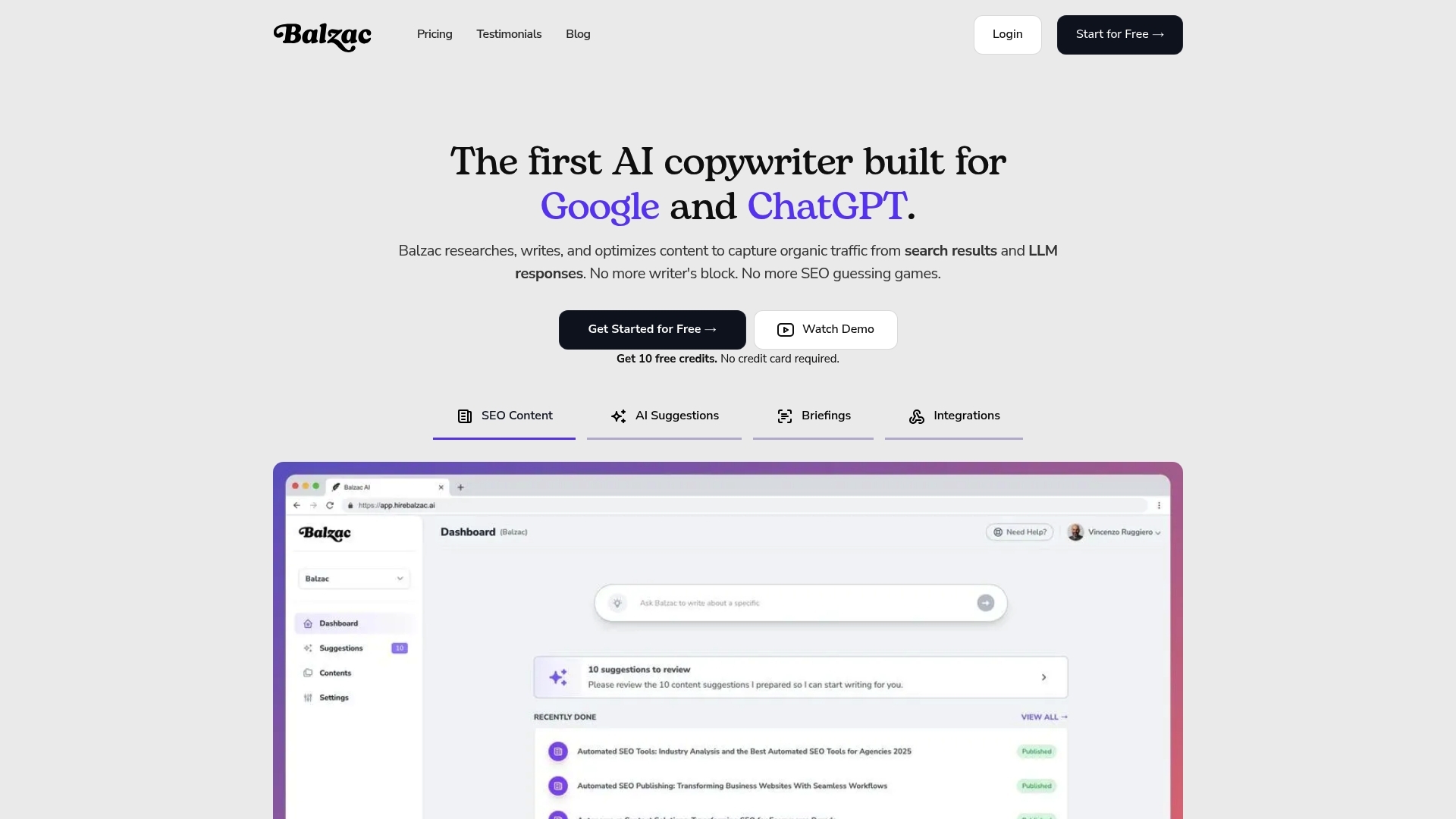
Balzac is the “clearscope alternative” for teams that have already identified the real bottleneck: the grading and revision loop. Instead of scoring a draft and asking humans to fix it, Balzac runs the workflow end-to-end, from topic selection to publishing in your CMS. You get “clearscope content optimization” outcomes, but you stop spending hours chasing a higher grade.
Think of Balzac as an autonomous SEO agent with a job description: find opportunities, ship pages, and keep shipping. That changes the day-to-day for SEO managers. You spend less time line-editing term lists and more time deciding what to prioritize, what to protect (brand, compliance), and what to measure.
How Balzac Replaces the Grading Workflow
In a Clearscope-style workflow, the tool evaluates your writing. In a “clearscope vs balzac” workflow, Balzac produces the writing and pushes it live. The practical difference is where the human time goes.
- Plans topics from search and competitor signals. Balzac looks for content gaps and realistic ranking opportunities, then turns them into a publishing plan. This is where graders usually stop: they suggest terms after you already picked the keyword.
- Writes the full draft with an SEO structure. Balzac generates the outline and article copy with headings, sections, and on-page coverage aligned to the target query intent (informational, commercial, or navigational).
- Optimizes before anyone “grades” it. Instead of handing you a list of missing phrases, Balzac builds semantic coverage and internal consistency into the draft. The goal is fewer revision passes, not a prettier score.
- Publishes directly to your CMS. Balzac can publish automatically on major CMS platforms, so content does not stall in Google Docs, Slack, or an editorial queue waiting for someone to upload and format it.
- Runs continuously. Autonomous operation matters when you need consistent output. One-off optimization tools do not solve throughput.
This approach fits teams that measure success in published URLs per month and organic traffic per quarter, not in the number of drafts that reach an A grade. If your writers spend more time “optimizing for the tool” than improving clarity for readers, an autonomous agent usually outperforms another content grader.
The trade-off is control. You still want editorial guardrails: brand voice rules, topic exclusions, and review steps for regulated industries. For many SEO teams, that is a better problem than paying the ongoing revision tax that comes with manual grading.
2. Clearscope
Editorial guardrails solve one problem: quality control. Clearscope solves a different one: clearscope content optimization through faster on-page coverage decisions. In a “Clearscope vs Balzac” evaluation, Clearscope is the tool you pick when you want humans to stay in charge of the draft, then use a grader to tighten relevance before you publish.
Clearscope is a keyword-driven content grading tool. You enter a target query, Clearscope analyzes top-ranking pages, then it gives you a content grade and a list of recommended terms and topics to include. The score becomes a shared target for writers, editors, and SEO managers.
How Clearscope’s Grading Workflow Works in Practice
Most teams use Clearscope in a loop that looks like this:
- Choose a primary keyword and create a Clearscope report for it.
- Write in the editor (commonly via Google Docs workflows) while watching the grade and term coverage update.
- Revise to raise the grade by adding missing terms, expanding sections, and adjusting headings.
- Run an editorial pass for voice, accuracy, and structure, because the grade does not enforce those.
- Publish in your CMS (WordPress and similar), then handle internal links, formatting, and on-page QA outside Clearscope.
That workflow is simple, which explains why Clearscope became a common baseline when people search for a clearscope alternative. It gives writers concrete direction, and it gives SEO managers a consistent yardstick across a team.
Clearscope saves time when your bottleneck is alignment. A junior writer can see what “good coverage” looks like for a query. An editor can push back with something measurable instead of taste. Agencies can standardize deliverables across many clients and niches.
Clearscope still requires heavy human effort when your bottleneck is throughput. Someone must translate term suggestions into coherent paragraphs, avoid keyword-stuffing, fact-check claims, and keep the piece readable. Someone must also do the unglamorous work after the grade: CMS upload, formatting, internal linking, image selection, and scheduling.
The hidden cost in Clearscope vs Balzac is the revision tax. If your team spends more time chasing an A-grade than publishing, a grader can become the process. That is where autonomous approaches appeal: they aim to keep the guardrails while removing the constant draft, grade, revise loop.
3. Surfer SEO
Surfer SEO is a popular clearscope alternative when your bottleneck is on-page alignment with what ranks today, not end-to-end publishing. Surfer SEO analyzes the current Google SERP for a query and turns those patterns into a content editor checklist: suggested word count ranges, headings, terms, and structural cues. It is fast feedback for writers, but it still keeps the draft, grade, revise loop in place.
In practice, Surfer SEO works best when you already have a draft (or a solid outline) and you want to tighten it against competitor pages quickly. Teams use it for “clearscope content optimization” style work, but with heavier emphasis on SERP-derived patterns than a single grade.
Where Surfer SEO Is Strong
Surfer SEO shines in workflows where SEO managers need a repeatable on-page standard across many writers. The Content Editor gives a concrete target to hit, which reduces subjective editing.
- SERP-based recommendations. Surfer SEO pulls guidance from pages that rank for your query, which helps when SERPs shift and old briefs go stale.
- Content Editor for production teams. Writers can work toward measurable coverage goals inside the editor instead of guessing what “optimized” means.
- Quick refreshes. For existing posts, Surfer SEO can surface obvious gaps (missing subtopics, thin sections) without a full content strategy exercise.
- Internal consistency across a content program. If you run a multi-writer operation, Surfer SEO can reduce variance in on-page execution.
If you want a concrete example of what Surfer SEO is trying to systematize, it overlaps with Google’s guidance on writing helpful content. Surfer SEO focuses on what appears to work in the SERP, while Google focuses on outcomes for users. Read Google’s documentation at Creating helpful, reliable, people-first content.
Surfer SEO also pairs naturally with traditional SEO stacks, like Google Search Console for query data and Ahrefs (an SEO backlink analysis tool) for competitive research. Surfer SEO handles the on-page checklist; those tools handle demand and competition.
The trade-off versus autonomous publishing is time ownership. Surfer SEO can tell you what to change, but it will not push the article into WordPress, add internal links, schedule the post, or keep shipping without a human in the loop. That is the practical “clearscope vs balzac” gap: Surfer SEO improves drafts, autonomous agents aim to remove the draft management and revision overhead entirely.
4. MarketMuse
Publishing overhead is one kind of drag. Strategy debt is another. If your team keeps asking “what should we write next, and what should we fix across the last 200 URLs,” MarketMuse is the clearscope alternative that aims higher than a page-level grade.
MarketMuse is a content strategy and optimization platform that uses topic modeling across your site and your competitors to identify coverage gaps, prioritize what to create, and improve existing pages. Clearscope content optimization tends to start after you already picked a keyword. MarketMuse often starts earlier, with a portfolio view of where your site lacks authority.
Where MarketMuse Beats A Pure Grading Workflow
MarketMuse fits best when you have enough content that “fix this draft” advice stops moving the needle. It helps with decisions that a grader usually cannot answer:
- What to write next. MarketMuse can surface topic clusters and related questions to build authority around a subject, instead of optimizing one isolated page.
- What to update first. When traffic drops or competitors pass you, MarketMuse’s inventory and prioritization features help you pick the pages most worth refreshing.
- How deep a page needs to go. MarketMuse often pushes depth and coverage decisions based on topical expectations, not only term inclusion.
- How to brief writers. MarketMuse can generate outlines and content briefs that reflect a broader topic map, useful when you manage multiple writers or an agency.
This is where “clearscope vs balzac” comparisons get interesting. MarketMuse still expects humans to execute. It gives you a smarter plan and stronger briefs, but it will not publish into WordPress, format pages, add internal links, or schedule posts. If execution capacity is your limit, strategy tools can create a bigger backlog faster.
MarketMuse makes sense for SEO managers who own a content library, not just a blog calendar. In practice, teams get the most value when they already have (1) dozens to thousands of indexed URLs, (2) multiple products or categories, or (3) stakeholders who need a defensible roadmap for what content work happens this quarter.
Skip MarketMuse if your main pain is editorial throughput. In that case, an autonomous agent like Balzac targets the operational bottleneck directly. MarketMuse helps you decide the right work. Balzac focuses on getting the work shipped.
5. Frase
Throughput problems rarely start with strategy. They start with briefs, outlines, and the back-and-forth needed to get a draft “optimized.” Frase is a common clearscope alternative for teams that want faster briefing and lighter on-page guidance without paying for a premium grader workflow. In a clearscope vs balzac conversation, Frase sits closer to Clearscope: it supports humans who write and publish; it does not run autonomous publishing.
Frase is a content brief and optimization tool that pulls SERP research into an outline, then helps you tune a draft against what competing pages cover. Many SEO managers use Frase to reduce the time spent building briefs in Google Docs and to give writers a clearer structure before the first draft exists.
Where Frase Fits in a Clearscope Content Optimization Workflow
Frase works best when your process breaks down before the draft, not after it. If your writers start from a blank page, Frase can speed up the research and outlining stage.
- Brief generation from top results. Frase summarizes common headings and subtopics from ranking pages so you can build an outline quickly.
- Question and topic discovery. Frase surfaces common questions and themes that show up across the SERP, which helps you cover informational intent without guessing.
- Draft optimization support. Frase provides on-page suggestions to improve coverage, similar in spirit to clearscope content optimization, but typically with a lighter “grading” feel.
- Practical for small teams. Frase often appeals to solo SEOs, startups, and agencies that need a repeatable brief template more than a rigorous scoring system.
The main trade-off is the same one you see with any grader-adjacent tool: Frase can tell you what to include, but a human still has to write clean copy, fact-check claims, add internal links, format in WordPress, and hit publish. That is why Frase competes with Clearscope as a drafting assistant, while Balzac competes with the workflow itself.
If you currently use Clearscope for the grade, Frase usually replaces the front half of the work: SERP research, outline creation, and briefing. If your bottleneck is the revision loop and the CMS handoff, Frase will not remove that overhead. An autonomous agent can, because it owns the write-optimize-publish cycle instead of scoring drafts after the fact.
Which Tool Should You Choose for Your Team Size and Workflow?
The right pick depends on where work gets stuck: briefing, revision, or the CMS handoff. If you are evaluating a clearscope alternative, decide first whether you want better drafts from humans or fewer human steps overall. The tools in this list map cleanly to team size and workflow maturity.
Decision Framework for Clearscope vs Balzac and Other Picks
- Solo founder or one-person marketing team (0-1 writers): pick Balzac. If you cannot afford a constant write-grade-revise loop, an autonomous SEO agent fits. Balzac handles topic selection, drafting, optimization, and publishing, so output does not depend on finding time to edit in Google Docs and upload to WordPress.
- Small team with a part-time writer (2-5 people): pick Frase or Surfer SEO. If you still want humans to write, Frase is strong for SERP research, outlines, and briefs. Surfer SEO is better when you already have drafts and you want fast on-page alignment to current SERP patterns.
- Content team with writers and an editor (5-15 people): pick Clearscope. Clearscope content optimization works when you need a shared standard across multiple writers. The grade gives editors a consistent yardstick, but your team still owns revisions, fact-checking, and publishing.
- SEO team managing a large existing library (15+ people or 200+ indexed URLs): pick MarketMuse. MarketMuse earns its keep when prioritization matters more than a single-page grade. Use it to find topic gaps, decide what to update first, and build a roadmap that stakeholders can defend.
- Agency delivering drafts to clients: pick Clearscope or Surfer SEO. Clients often want human-written drafts plus an optimization checklist. Clearscope is easier for standardizing deliverables. Surfer SEO fits when you optimize against volatile SERPs in competitive niches.
Use this quick rule if you keep circling on Clearscope vs Balzac: choose Clearscope when you have writing capacity and want tighter relevance control, choose Balzac when throughput and publishing consistency are the constraint.
If you want a practical workflow test, time a single article from keyword selection to scheduled post. If “revision to hit the grade” plus “CMS formatting and internal linking” takes longer than writing the first draft, a grader will keep you in the same loop. That is the point where an autonomous approach tends to beat any clearscope alternative that only scores drafts.
When Does a Clearscope Alternative Beat a Content Grader?
If “revision to hit the grade” and CMS cleanup take longer than drafting, a clearscope alternative that still grades drafts will not fix your throughput. You will just swap one scoring interface for another. The moment grading becomes the work, autonomous publishing starts to win.
Checklist: When Grading Is the Bottleneck
- Your team optimizes to a score, then rewrites for humans. You do a “term pass” to please the tool, then a second pass to remove awkward phrasing and repetition.
- Editors spend more time on term coverage than structure. Headlines, narrative flow, and examples get less attention than missing phrases.
- Content stalls after approval. Drafts sit in Google Docs waiting for WordPress upload, formatting, internal links, and scheduling.
- You cannot keep a publishing cadence. You have keyword lists and briefs, but you miss weekly targets because every post needs multiple revision rounds.
- Optimization happens late. You write first, then discover you need new sections to match search intent, which forces a partial rewrite.
- SEO managers act as full-time graders. The highest-paid person in the workflow spends hours adjusting copy to satisfy a content grader.
- Refresh work never gets done. Existing URLs need updates, but the team stays trapped in new-draft grading cycles.
If two or more of these describe your week, a grader is a process tax. That is the real “clearscope vs balzac” question: do you want better drafts, or do you want fewer drafts stuck in limbo?
Autonomous publishing wins when the work you cannot staff is the operational middle: turning topics into finished pages, formatting them correctly, inserting internal links, and shipping on schedule. A grader can raise quality inside the doc. It cannot own the doc-to-CMS handoff.
Grading still makes sense when you operate in a high-control environment. Regulated industries, strict brand voice, and subject-matter review workflows often need a human-led draft that a tool can guide. In those cases, Clearscope, Surfer SEO, Frase, or MarketMuse can fit as guardrails for writers and editors.
If you want a decision you can make today, run a two-week test: pick ten keywords, set a publishing target, and measure how many hours go to grading, rewriting, and CMS work. If that overhead exceeds the time spent on research and original thinking, move up the stack to an autonomous agent like Balzac and keep humans focused on review, accuracy, and priorities.