
You can get a Byword draft in minutes. The part that usually eats your week starts right after: keyword picking, intent checks, on-page SEO, formatting, internal links, metadata, and pushing the post into your CMS.
If you are searching for a Byword alternative, the real question is simple: do you want an AI writer you operate, or an SEO agent that runs the pipeline for you?
Byword is a straightforward AI article writer. You bring the keyword, the angle, and the constraints, then you handle the research, editorial QA, and publishing. If you already have a working process and you mainly want faster first drafts, Byword can fit.
Balzac is built for teams that want content to ship without living in briefs, Google Docs, and CMS tabs. It researches keywords, plans topics, writes, and publishes on a schedule. If your goal is a weekly cadence with fewer human steps, that difference matters.
This Byword vs Balzac comparison breaks down seven differences that change workload, rankings, and how reliably you can keep publishing once the novelty of “instant drafts” wears off.
Feature Comparison Table: Byword vs Balzac at a Glance
Workload and publishing reliability come down to one question in this Byword vs Balzac matchup: do you want an AI writer you operate, or an SEO agent that operates your content pipeline? The table below makes the differences scannable if you are evaluating a Byword alternative for higher automation.
| Category | Byword | Balzac |
|---|---|---|
| Keyword Research | Primarily user-driven. You bring the topic or keyword. | Autonomous research and topic discovery oriented around SEO outcomes. |
| SEO Planning | Limited planning. Works best with a pre-made brief. | Plans content around search intent and coverage, then executes end-to-end. |
| Draft Controls (Quality, Structure) | Good for fast drafts. Consistency depends on your prompts and editing process. | Systemized outputs with repeatable constraints, designed for publish-ready posts. |
| Brand Voice | Prompt-based voice guidance. | Voice and formatting rules applied across runs to keep a stable house style. |
| On-Page SEO Execution | Basic SEO-friendly writing. You handle most on-page checks manually. | Built for on-page execution (entities, structure, metadata) as part of the workflow. |
| Internal Linking | Manual. You add links during editing. | Designed to support internal linking as part of publishing operations. |
| CMS Integrations | No CMS integrations for automated publishing. | Publishes automatically to major CMS platforms as part of its core job. |
| Automation Level | Assisted writing. Humans still run the process. | Zero-touch capable content ops (research, write, publish) on a schedule. |
| Collaboration | Lightweight. Review happens outside the tool in many teams. | Workflow-oriented for teams that want fewer handoffs and fewer moving parts. |
| Best Fit | Solo creators who want a simple Byword AI writer for quick articles. | Teams that want a content system that runs weekly without a writer. |
| Pricing Approach | Writer-style pricing tied to generating content. | System-style pricing tied to automation and publishing throughput. |
If you mainly need drafts, Byword stays simple. If you want content to ship with minimal human involvement, Balzac is built around automation, CMS publishing, and repeatability, which is why it tends to win as a Byword alternative for operational teams.
1. Keyword Research and Topic Discovery
Automation lives or dies at the first step: picking keywords that can actually win. In a Byword vs Balzac evaluation, this is where the tools split fast. Byword assumes you already know what to write about. Balzac treats topic discovery as part of the job.
Byword is a Byword AI writer, not a keyword research tool. You typically arrive with a keyword from Ahrefs (SEO backlink analysis tool), Semrush (SEO suite), Google Search Console, or a spreadsheet from your SEO lead. Then you generate a draft. That workflow works when you already have a reliable research process, but it also means Byword will not surface opportunities you missed, such as low-competition long-tail queries, adjacent intents, or competitor gaps.
Balzac starts earlier in the pipeline. It can research topics and keywords, cluster them into a plan, and then write based on that plan. Practically, that changes the weekly workload: you spend time setting direction (site, audience, products, competitors), then the agent keeps finding publishable topics without someone manually mining Ahrefs exports.
How Topic Discovery Actually Works in Each Tool
Use this mental model when choosing a byword alternative for SEO scale:
- Byword: You provide the seed keyword, angle, and constraints. The output quality depends on your inputs and your research hygiene. If your keyword list is thin, the content calendar stays thin.
- Balzac: You provide the business context and guardrails. Balzac can generate topic ideas based on search demand and competitive context, then turn those ideas into a queue of articles.
If you run a niche site with a tight editorial thesis, Byword can be enough because you already know the topics. If you run a company blog where the backlog constantly runs dry, Balzac’s autonomous discovery is the difference between publishing “when we have time” and publishing every week.
Either way, validate the final targets in Google Search Console and check live SERPs before you commit to a month of content. Google’s results page tells you the real intent mix, which no writing tool can guess perfectly.
2. Content Briefs, Outlines, and Search Intent Matching
SERP intent is the part Google will punish you for getting wrong. In a Byword vs Balzac evaluation, this is where the tools start to feel different: can they turn a keyword into a brief and outline that match what already ranks, or do you have to do that thinking yourself?
Byword works best when you arrive with a clear brief. You can paste a keyword and ask for an outline, but the quality of intent matching depends on your steering. If the SERP is split between “how-to,” “best X,” and “X vs Y,” you need to decide which angle you want and then prompt for it explicitly. That makes Byword a fine Byword AI writer for teams that already use a briefing stack like Google Docs plus Ahrefs (SEO backlink and keyword research tool) or Semrush (SEO and competitive research suite) to lock intent before writing.
Balzac treats the brief as part of the job. It builds an outline from the SERP reality, then writes to that structure with fewer manual edits. In practice, that means Balzac can pick the right page type (listicle, comparison, definition, template), map sections to subtopics that show up across top results, and keep the article aligned with the query’s “job to be done.”
How Much Manual Steering Each Tool Needs
If you are looking for a byword alternative because briefs keep eating your week, compare the workflows, not the prose.
- Byword workflow: choose the intent angle, write the brief (audience, promise, constraints), draft an outline, then generate. You usually iterate several times to get headings that match the SERP.
- Balzac workflow: set guardrails (site, audience, voice rules, topics to avoid), then let the agent generate a brief and outline aligned to the query and competitive pages.
The difference shows up in edge cases. For example, “best CRM for startups” expects a list with categories, pricing, and selection criteria. “how to choose a CRM” expects a process guide with steps and pitfalls. Byword can write either, but you must specify the format and what to cover. Balzac is designed to infer the format from what ranks, then structure the outline accordingly.
If you want hands-on control, Byword stays comfortable. If you want consistent intent matching at scale, Balzac reduces the briefing burden that usually blocks weekly publishing.
3. Draft Quality, Editing Controls, and Brand Voice
Intent matching is worthless if the draft still reads like a generic template. In a Byword vs Balzac evaluation, draft quality comes down to two things: how much you can constrain the output, and how consistently the tool applies those constraints across dozens of posts.
Byword generally produces a clean first draft fast, but quality control stays in your hands. You get the best results when you arrive with a tight brief, specific headings, and clear “do and don’t” rules. Without that, Byword can drift into broad explanations, repeat points, or miss the exact angle that makes an article feel written by your team.
Balzac aims for repeatable, publish-ready drafts because it is designed to run as a system. The output tends to look more standardized across posts, with consistent formatting rules and fewer “one-off” prompt hacks. That consistency matters if you want to publish weekly without re-editing every paragraph into your house style.
Editing Controls and Brand Voice: Where Each Tool Fits
Byword AI writer workflows usually rely on manual steering. You control voice and structure through prompts and inputs, then you edit in Google Docs, Notion, or WordPress. For many teams, that is fine, but it makes consistency a people problem. Two different editors can turn the same Byword draft into two very different posts.
Balzac treats voice as an operational requirement. You set guardrails once, then Balzac applies them across runs so your blog keeps a stable “sound.” This is the difference between “we can get a draft” and “we can ship a post that looks like it belongs on our site.” If you are shopping for a byword alternative because you keep rewriting intros, tightening sections, and fixing formatting, this is the gap you feel day to day.
Use this quick test to judge publish-readiness in either tool:
- Structure: Does the article follow a predictable layout (definitions, steps, comparisons) without filler?
- Specificity: Does it name real tools, companies, and actions, or does it stay generic?
- Voice: Do intros, headings, and CTAs sound like one brand across multiple posts?
- Edit Time: Can an editor finish in 10 to 20 minutes, or does it need a rewrite?
If you like hands-on editing, Byword stays efficient. If you want consistent drafts at scale with fewer human fixes, Balzac is built for that operating model.
4. SEO Optimization and On-Page Execution
Consistent drafts are only half the work in a Byword vs Balzac decision. Rankings usually come down to on-page execution: covering the right entities, building internal links, and shipping clean metadata every time. This is where a simple Byword AI writer workflow starts to feel manual, and where a more automated byword alternative earns its keep.
Byword can produce SEO-friendly prose, but it does not run an on-page SEO checklist for you. In practice, you end up doing the “SEO pass” in other tools: checking entity coverage against competitor pages, adding internal links, writing titles and meta descriptions, and making sure headings map to the intent you chose. Teams commonly lean on Surfer SEO (content optimization tool), Clearscope (keyword and content grading), or Frase (SERP-based content briefs) for this part of the workflow.
Balzac treats on-page SEO as part of the agent’s job, not a separate editing phase. It aims to produce a draft that already has the structure, topical coverage, and publish-ready fields you would otherwise assemble by hand.
On-Page SEO Tasks That Create the Biggest Workflow Gap
- Entity and topic coverage: Byword relies on your prompt and your editing. Balzac is built to include relevant entities and subtopics as part of the writing process, so the article reads like it belongs in the SERP.
- Internal linking suggestions: Byword leaves internal linking to the editor. Balzac is designed to support internal linking as an operational step, so posts connect into clusters instead of shipping as isolated pages.
- Metadata generation: Byword typically needs manual titles, meta descriptions, and slug decisions. Balzac is built to generate these fields consistently, which matters when you publish at volume.
- Optimization loops: With Byword, you iterate by re-prompting and re-editing. Balzac is designed for repeatable runs with guardrails so each article follows the same on-page rules.
If you enjoy doing the SEO pass yourself, Byword stays workable. If you want fewer steps between “draft” and “ready to publish,” Balzac’s on-page execution focus is a practical advantage for teams trying to run content like a system.
5. CMS Integrations and Auto-Publishing Workflows
The gap between “ready to publish” and “live post” is where most Byword vs Balzac evaluations get decided. A Byword AI writer draft still has to move through your CMS workflow, and that workflow usually includes formatting, adding internal links, setting metadata, uploading images, and scheduling.
Byword does not offer CMS integrations for automated publishing. In practice, you export text, paste it into WordPress, Webflow CMS, Ghost, or Shopify, then do the production work by hand. That is fine if you publish occasionally or you already have an editor in the loop. It breaks down when you try to run a weekly cadence, because every post becomes a checklist in multiple tabs.
Balzac is built around the opposite assumption: the system should publish. It is designed to push content live on a schedule as part of the same workflow that researched the topic and wrote the draft. If you are hunting for a byword alternative because “drafts” still leave you with two hours of CMS work, this is the operational difference that matters.
What “Auto-Publishing” Actually Includes
Teams often say they want auto-publishing when they really mean “remove the CMS busywork.” Compare the workflow steps below when you evaluate Byword vs Balzac for production publishing.
- CMS formatting: headings, lists, tables, block structure, and cleanup after paste.
- On-page fields: title tag, meta description, slug, categories, tags, and featured image.
- Internal linking: adding links to relevant existing posts so the new page sits in your site structure.
- Scheduling: setting publish dates, avoiding collisions, and keeping a consistent cadence.
- QA: checking the rendered page for broken formatting, missing images, and weird spacing.
With Byword, humans own every step after generation. With Balzac, the goal is a single system that carries the post from draft to published page with minimal manual intervention.
If you run content through approvals, Byword can still fit. You can keep drafts in Google Docs or Notion, then publish manually when stakeholders sign off. If your priority is zero-touch operations, Byword’s lack of CMS integrations is the hard limit, and Balzac’s publishing-first workflow is the reason teams switch.
6. Zero-Touch Content Ops: Can You Run This Weekly Without a Writer?
Byword vs Balzac becomes a simple question when you try to run a weekly publishing cadence: can the tool ship end-to-end without a writer watching every step? If you want “zero-touch” content ops, Byword typically cannot do it reliably because humans still have to research, QA, and publish. Balzac is built for scheduled execution, so a small team can keep posts going out with far less manual work.
Byword is an AI drafting tool. You can batch-generate articles, but a person still has to bring the keyword list, verify intent in the live SERP, add internal links, write metadata, format in the CMS, and hit publish. That is workable for creators who enjoy editorial control. It breaks down when the goal is “publish every Tuesday” and nobody has time to babysit the pipeline.
Balzac is designed to run like an SEO production system. It can research topics, write, and publish automatically, which is the core requirement for a weekly cadence without a dedicated writer. You still want a human involved, but the role shifts from writing and uploading to setting guardrails and reviewing exceptions.
Zero-Touch Weekly Ops: What Still Needs a Human?
Any byword alternative that promises autonomy still needs governance. The difference is how often you intervene.
- Strategy and boundaries: Someone defines the audience, product positioning, and topics to avoid. This is quarterly or monthly work, not per-article work.
- Approval workflows: If legal or brand approvals are mandatory, Byword forces a manual publish step. Balzac can still run, but you configure review gates and accept slower throughput.
- Fact and claim risk: Regulated topics (health, finance, legal) require stricter review. Byword makes that review the default because humans already touch everything. Balzac can publish hands-free, so you need tighter guardrails and spot checks.
- Internal linking and site hygiene: Byword leaves linking to editors, so clusters often lag. Balzac is built to treat linking as part of publishing operations, which matters once you have hundreds of posts.
If you want a byword alternative because you are tired of briefs, edits, and CMS busywork, the operational answer is straightforward: Byword can help you write faster, but Balzac is the option that can keep shipping weekly with minimal human involvement.
7. The Contrarian Cost Test: Cheapest Tool vs Cheapest System
“Cheap per article” is the trap in most Byword vs Balzac decisions. A Byword AI writer can look like the lower-cost option because the draft appears quickly. The real cost shows up in the system around the draft: briefing, SEO checks, editing, and CMS production. When you price the whole workflow, the “cheapest tool” often becomes the most expensive way to publish.
This is why a byword alternative that automates research and publishing can win on total cost, even if the sticker price looks higher. You stop paying the hidden tax of context switching and manual QA.
Cost Test: Price the Whole Workflow, Not the Draft
Run this contrarian test on your own team. Pick one typical post and time each step in minutes. Then multiply by your loaded hourly rate (salary plus taxes, benefits, overhead). If you want a benchmark, many teams use $50 to $150 per hour for marketing labor, depending on seniority.
- Briefing and intent choice: SERP review, angle selection, outline constraints.
- Draft generation and iteration: prompt cycles, structural fixes, missing sections.
- SEO pass: entity coverage, internal links, title tag, meta description, slug.
- Editing: voice consistency, trimming filler, adding product specifics, fact checks.
- CMS production: formatting blocks, images, categories/tags, scheduling, rendered-page QA.
Byword usually reduces the “draft generation” time. It does not remove the other line items. Teams still open Ahrefs or Semrush for keywords, Google Search Console for validation, and WordPress or Webflow CMS for production. Those tools are fine, but you are still operating a manual assembly line.
Balzac targets the assembly line itself. When an agent researches, writes, and publishes on a schedule, you buy back hours that never show up in a per-article price. The practical outcome is fewer handoffs, fewer tabs, and fewer posts stuck in “almost ready.”
If you publish once a month, Byword’s simplicity can be the cheapest path. If you publish weekly or more, the cheapest system is the one that removes recurring human steps, not the one that generates the lowest-cost draft.
Balzac Pricing and How to Get Started Fast
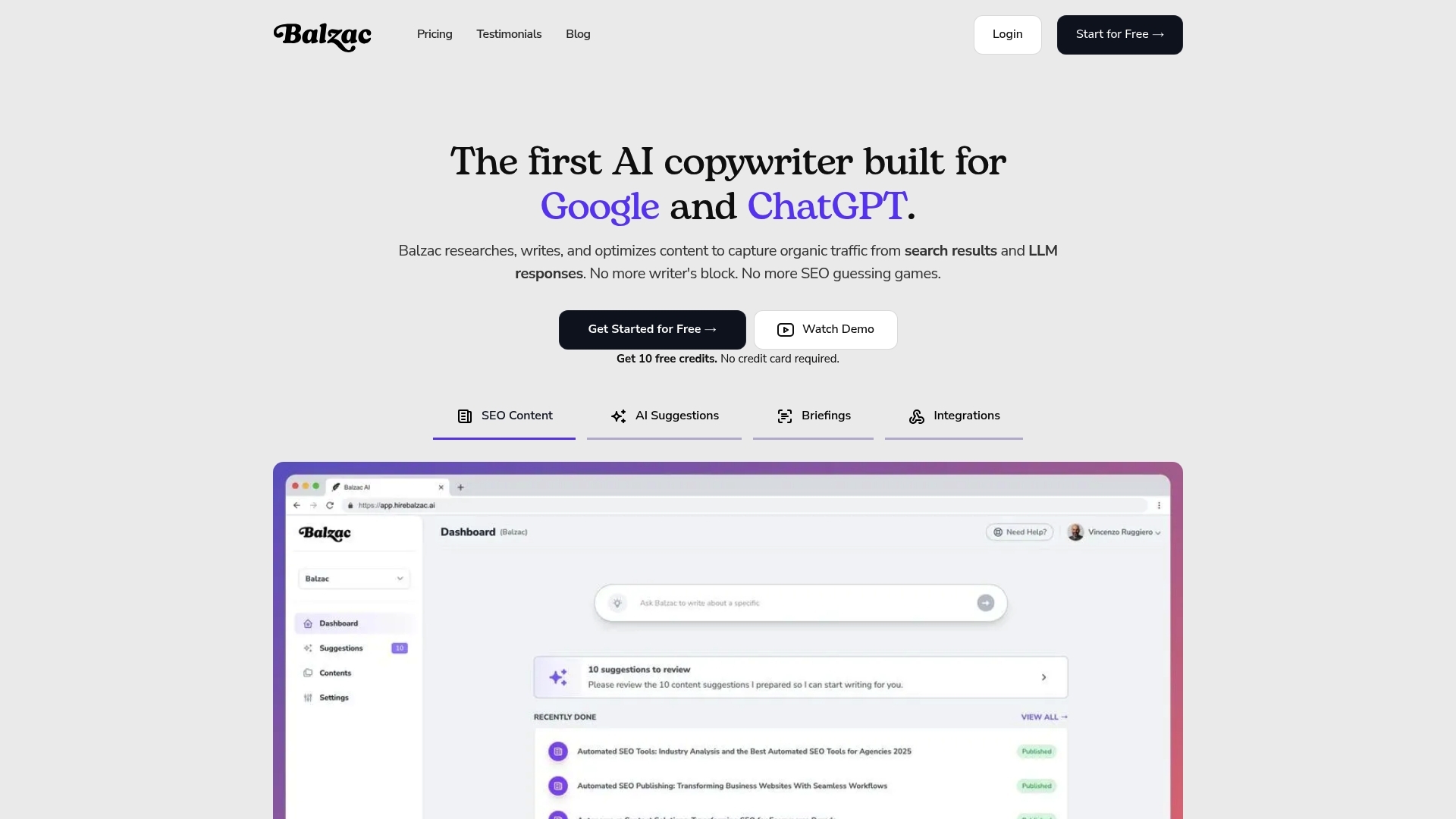
If you are weighing Byword vs Balzac and the real goal is to remove recurring human steps, pricing needs to map to throughput and autonomy, not “cost per draft.” Byword pricing tends to make sense when you already have a human process for research, editing, and publishing. Balzac pricing makes sense when you want the system to research, write, and publish on a schedule.
Balzac’s plans are built around how much content you want shipped per week or month, and how hands-free you want the workflow to be. If you are evaluating a byword alternative because your backlog keeps stalling in briefs and CMS work, choose the plan based on the operational load you want to eliminate.
How to Pick a Balzac Plan (Based on Content Volume)
Use these buckets to choose quickly:
- Light cadence (1 to 4 posts/month): best for small sites proving a channel. You still want automation, but you will review more closely and iterate on guardrails.
- Weekly cadence (1 to 2 posts/week): best for most company blogs. This is where Balzac usually beats a Byword AI writer workflow because the time savings compound every week.
- High cadence (3+ posts/week): best for programmatic SEO, marketplaces, and content-led growth teams. At this volume, manual publishing and internal linking become the bottleneck, so autonomy matters more than generation speed.
If your team already uses Ahrefs or Semrush for keyword lists and a human editor for CMS production, Byword can stay the cheaper choice. If you want content to go live without someone copying into WordPress, Webflow, or Ghost every week, Balzac’s automation changes the cost structure.
Get Started Fast Without Overthinking Setup
- Set guardrails: define your audience, products, voice rules, and topics to avoid.
- Connect publishing: point Balzac at the CMS you use so “done” means “published.”
- Start with one content cluster: pick a tight theme (for example, “CRM onboarding” or “SOC 2 compliance”) and ship consistently for a month.
- Review exceptions: spot check claims, links, formatting, and intent alignment, then tighten the rules once.
For plan details and exact pricing, go straight to https://hirebalzac.ai/pricing. If you want the simplest recommendation: choose Balzac when you want the cheapest system, because the system that publishes for you is the one that keeps shipping.